One of the great things about living in the American West is how easy it is to get to truly amazing locations without having to pull out the passport. You can feel like you’ve been transported to someplace far and exotic, even after driving only a few hours. And no place exemplifies this more than Yellowstone National Park.
If you’ve never been to Yellowstone, it’s well worth the visit. I spent two days exploring West Yellowstone and the North Entrance with my bestie/travel buddy, and I would highly recommend it to all and sundry. A mixture of rolling plains, mountain scenery, and thermal hotspots that look like they belong on an alien world, it was a much-needed break and emotional reset from the toil of office life.
Touring Yellowstone
I wouldn’t consider myself “outdoorsy.” I’m not into camping (I require indoor plumbing, thank you). Long, vertical hikes also aren’t my thing. But I do like spending time in nature, and I can walk for a good long while. Fortunately, Yellowstone offers something for most fitness levels. Many of the popular sights have parking lots close by, and the park has a pretty extensive network of wooden walkways around its natural wonders so you can get a good look without damaging them—or yourself.
There are also some pretty intense hikes. Even some of the paths that have stairs (rough and broken stone stairs) will have you going down and then back up several hundred feet. But there are many walkways that stay on a relatively even keel or have manageable steps. You’ll want to bring sturdy shoes you can walk in, but hiking boots aren’t necessary.
We went in early October of 2024 and the weather was just about perfect. It was chilly during the morning and evenings, but warm enough at mid-day that I didn’t need more than my long-sleeve shirt most of the time. However, we all know that weather can be unpredictable, so plan accordingly.
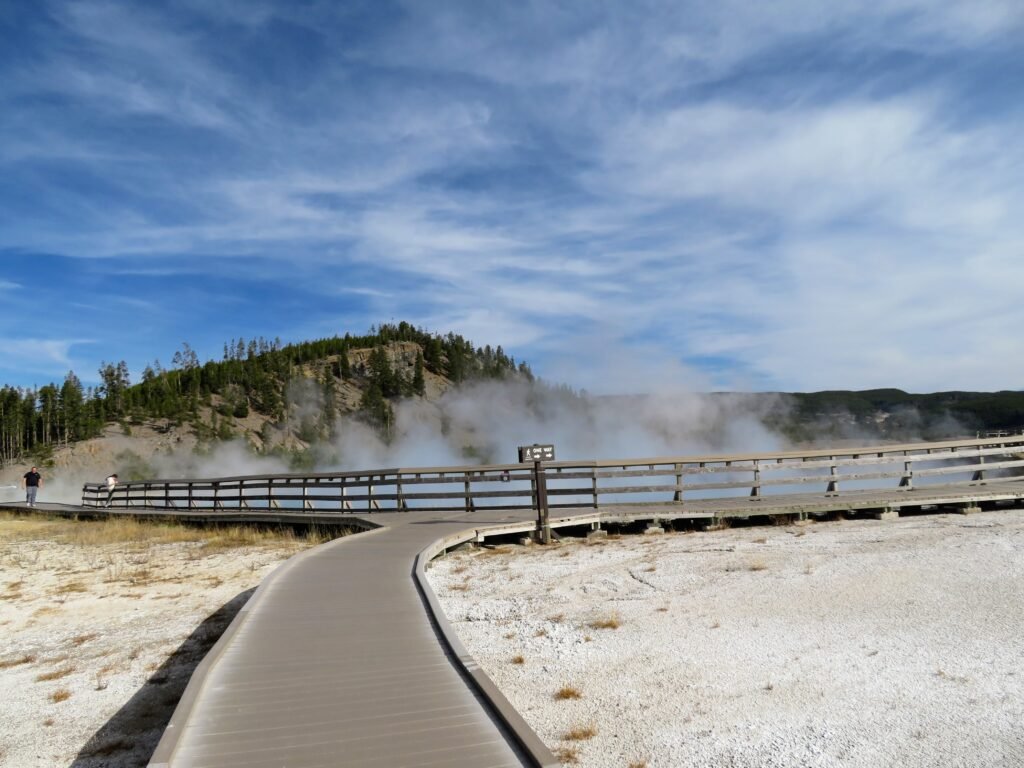
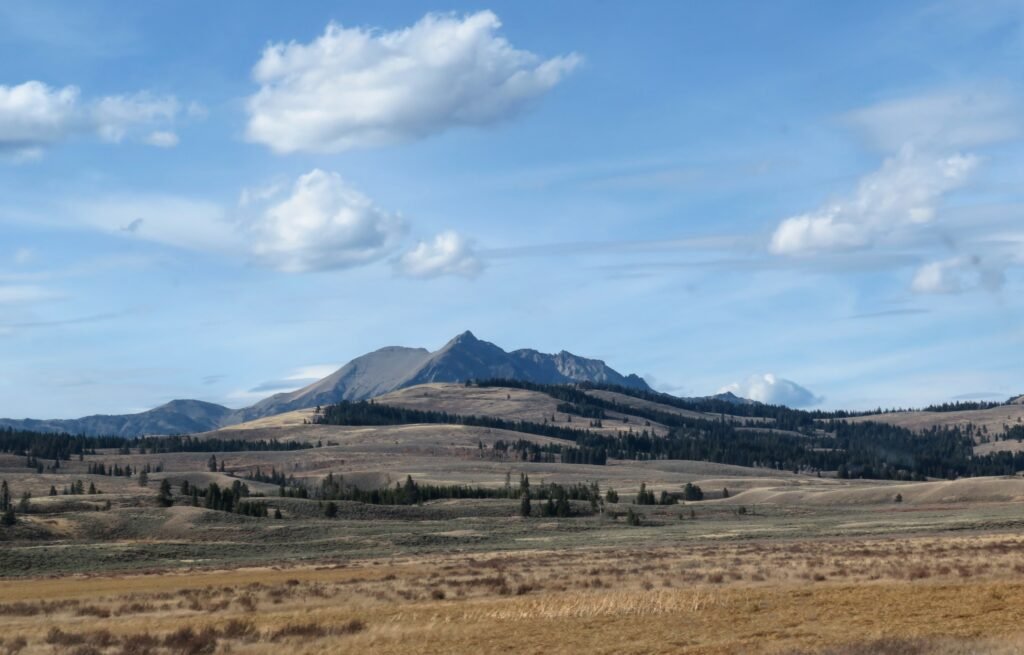
Driving around Yellowstone means that you have the opportunity to take plenty of supplies with you. There are some restaurants around Yellowstone, such as near Old Faithful. But not every attraction has a place to eat, though many of the spots do have restrooms (Yay!).
We took a cooler with snacks and sandwich supplies. I’d highly recommend doing this so you can eat on your schedule. Just don’t litter! Also, even though people aren’t supposed to feed the birds, our feathered friends have learned that where people are, an easy meal will follow. One tried to divebomb my head while I was pulling a sandwich out of a cooler in the parking lot, so be aware!
Terrace Spring
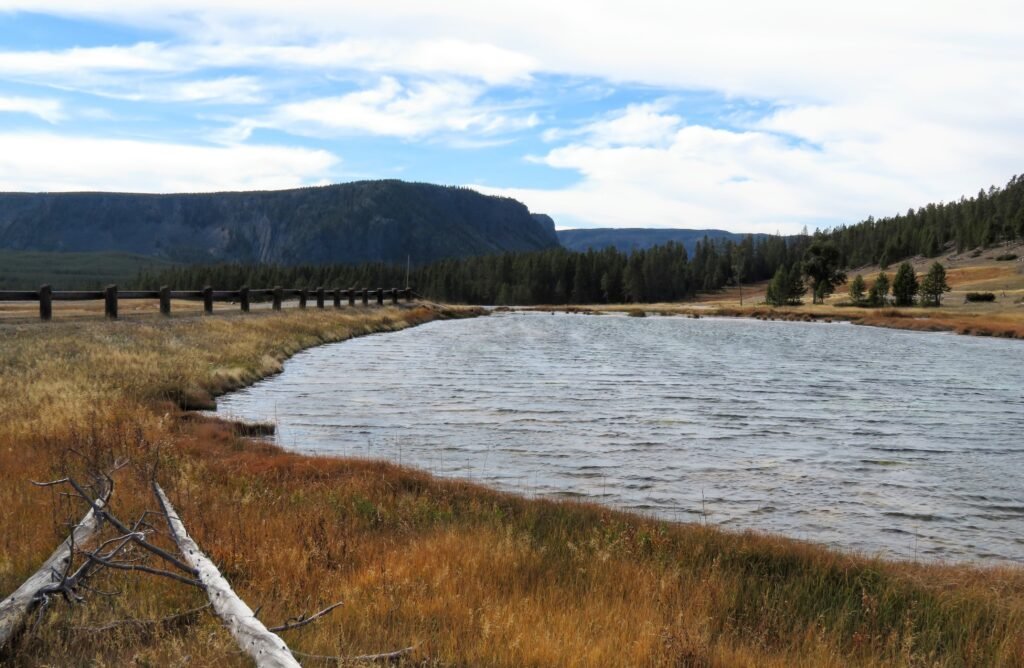
My favorite thing about Yellowstone is how what seem to be completely normal-looking areas are clearly…not quite normal when you really look at them. Our first stop was one such place.
Terrace Spring isn’t one of the major attractions. I don’t recall seeing it on any postcards or hearing anyone mention it when talking about their trip. Even so, it can take you by surprise. Boardwalks wind around a series of pools nestled among the grass. At first, it looks like a perfectly normal series of ponds. But then you notice the bubbling waters and patches of iridescent green beneath the surface, and this serves as the first clue that you’ve arrived someplace a little different.
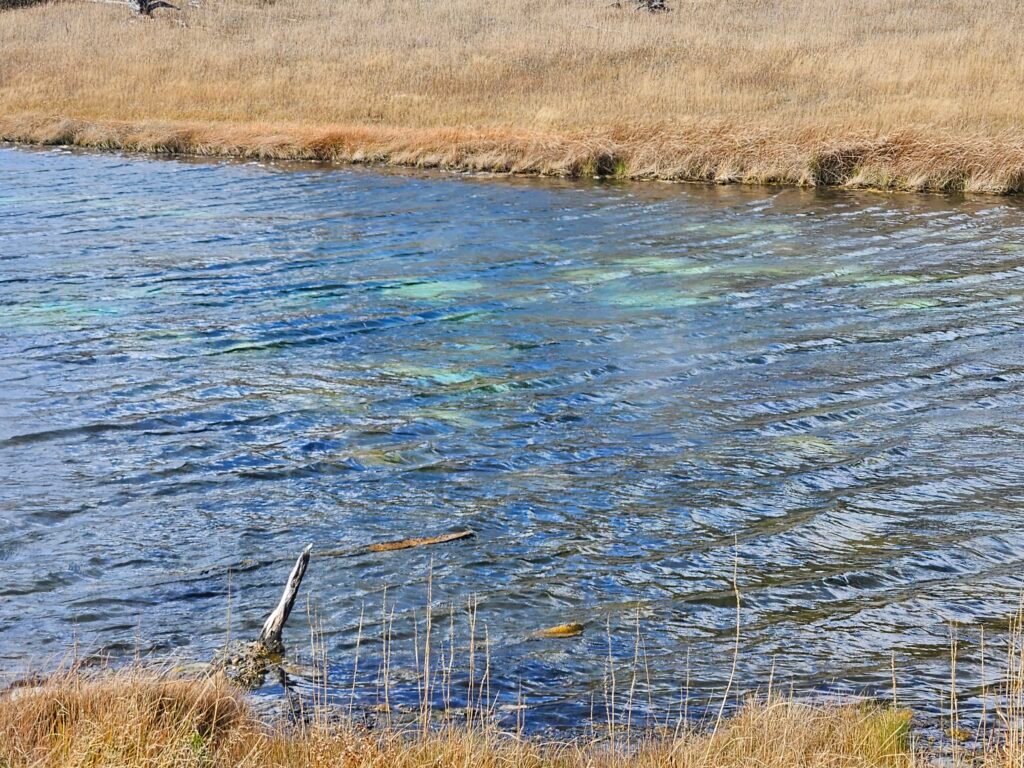
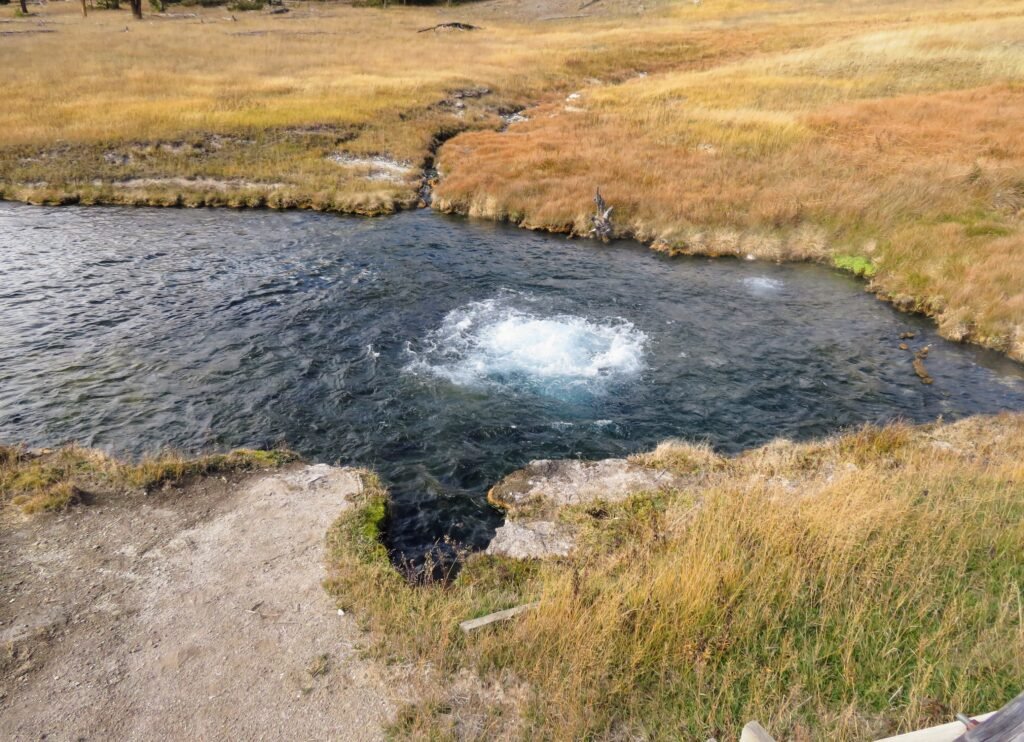
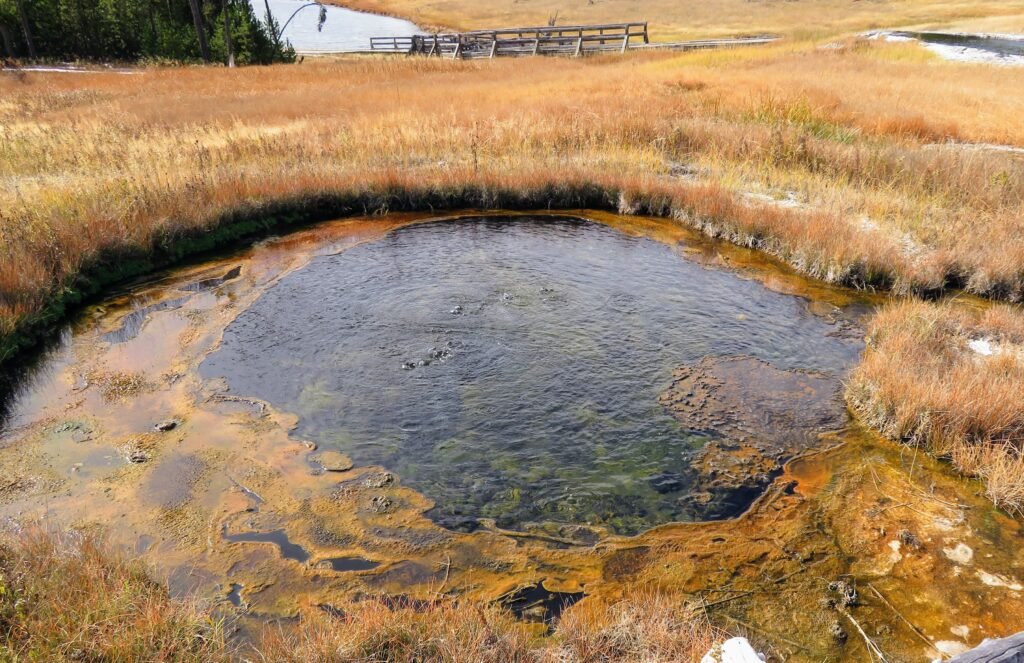
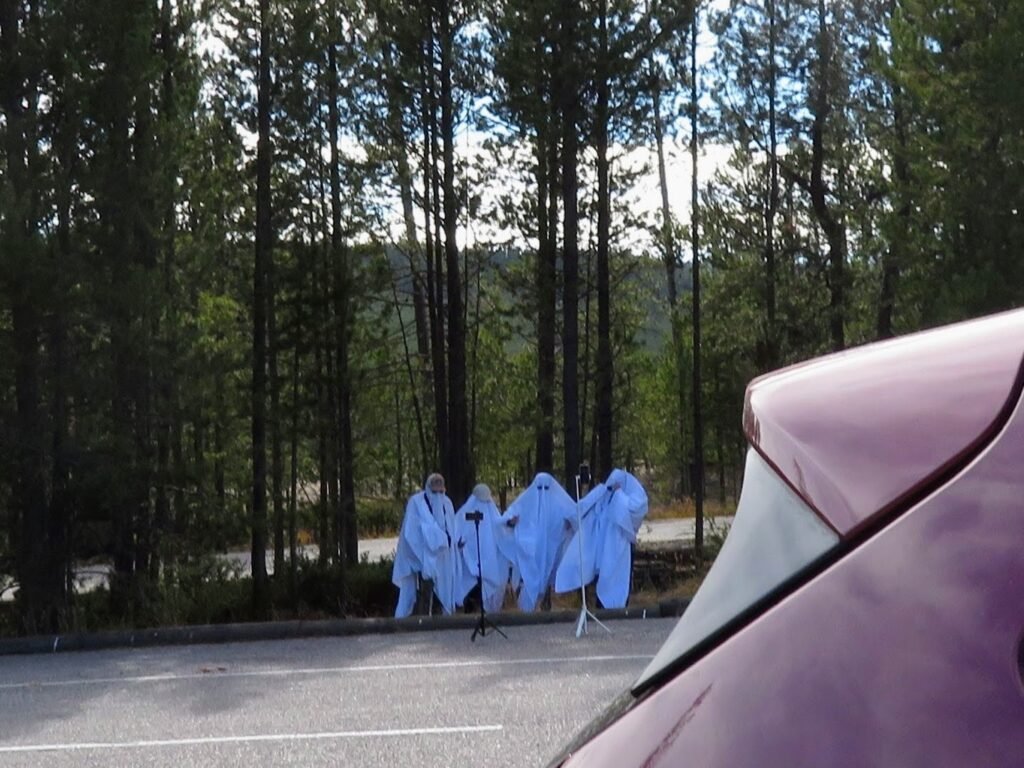
Yellowstone is supposedly home to a few ghosts (you can read about them here), and we got our own glimpse of some. I don’t know what these people were doing, but they gave me a good laugh. If you happen to be one of the people in this picture and you somehow come across this, what’s the story?
Either way, our first stop at Yellowstone gave me only a glimpse of what was to come.
Enter the Animals
I was really excited to see the wildlife of Yellowstone. Being solidly ensconced in the suburbs for most of my life, I still get excited when I see animals not native to the streets of my neighborhood. Where I currently live, I am close enough to nature that I do get to see deer wandering through the area, often passing them when I go for a walk. But I’m not so close that I’ve had to worry about mountain lions.
Should I be worrying about mountain lions?
A question for later.
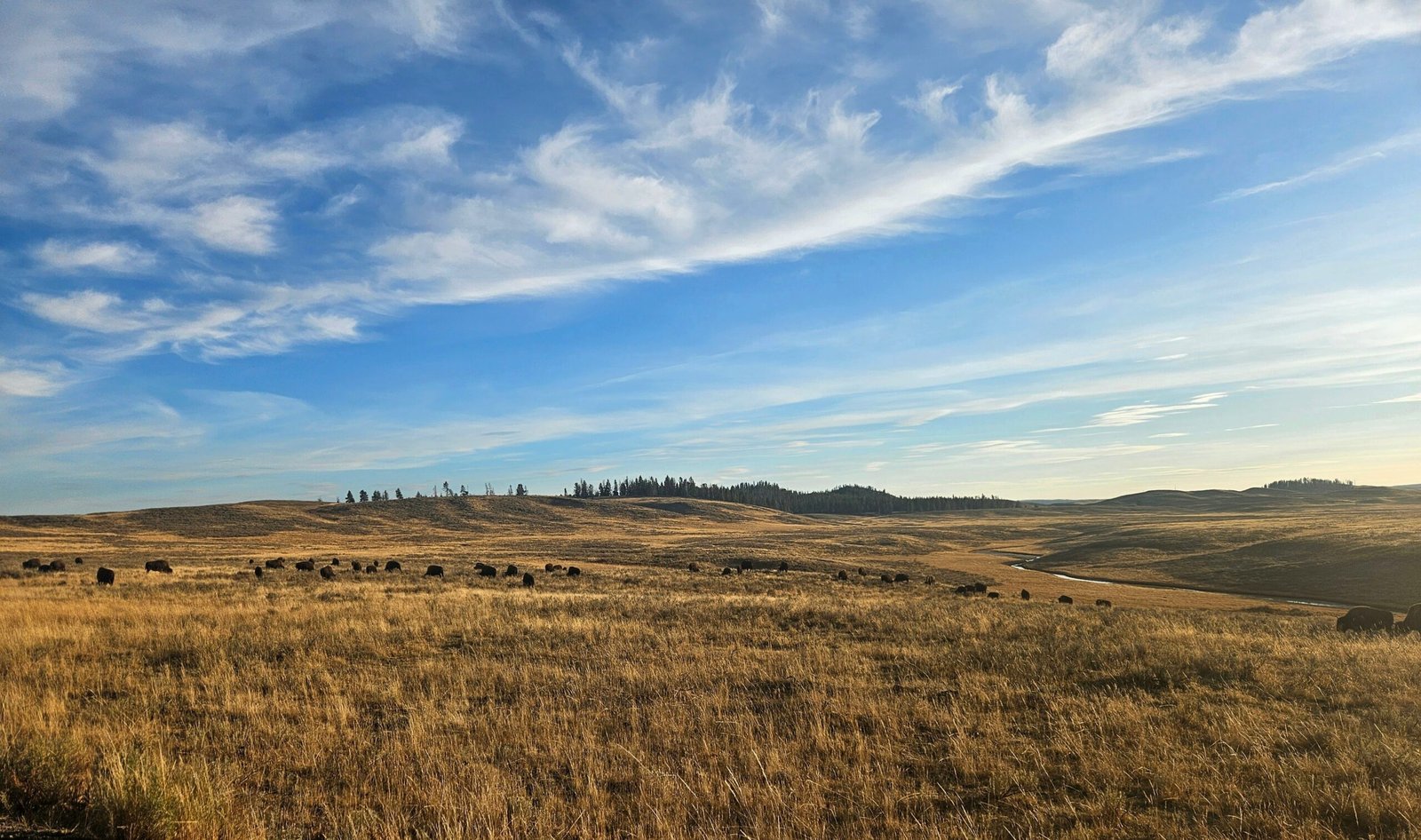
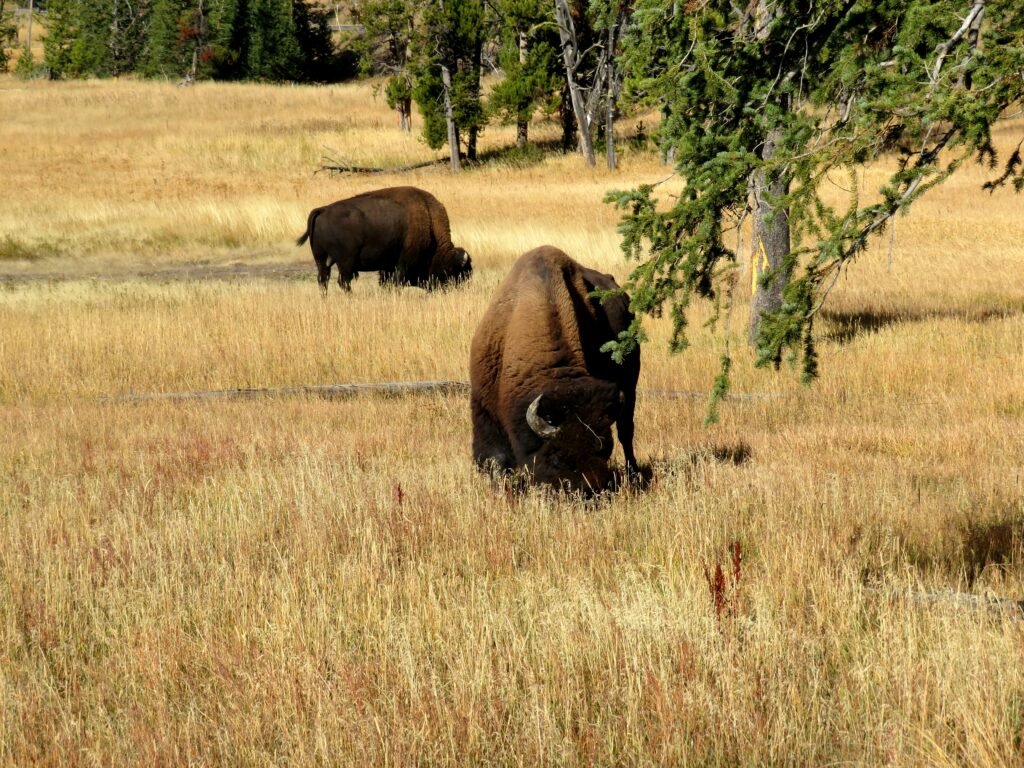
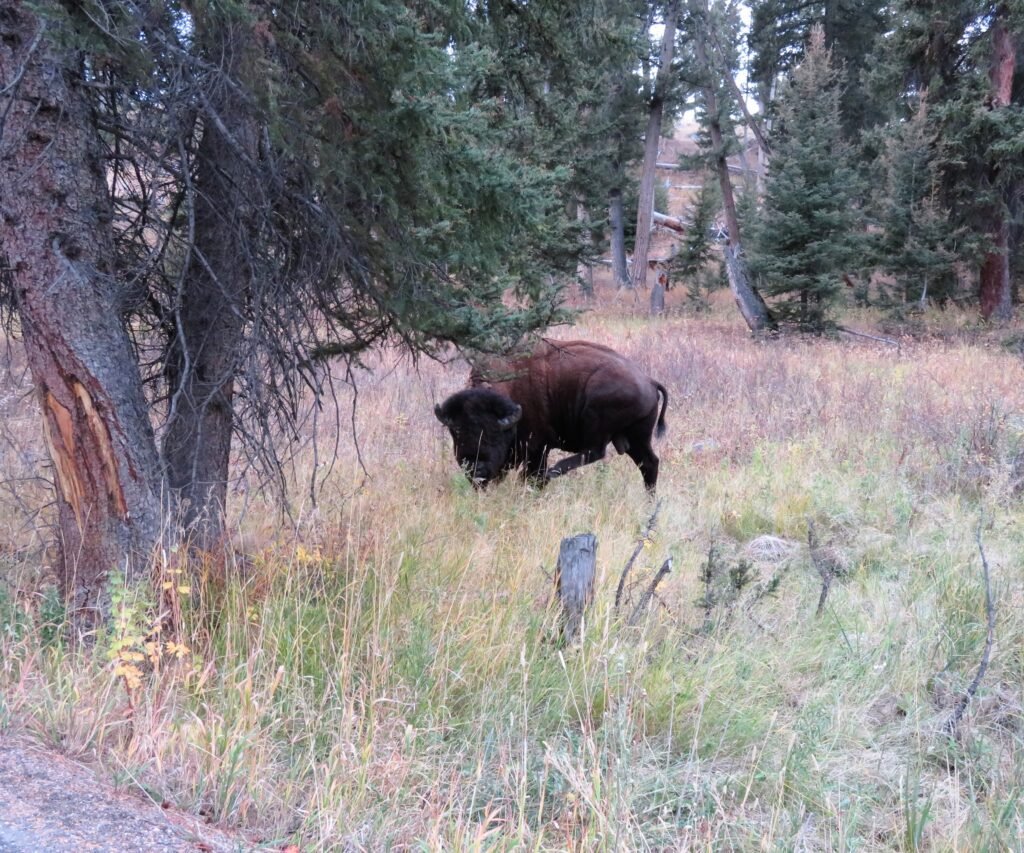
My first sighting of actual wildlife came probably an hour into our drive through the park. A small herd of bison hanging out in the long yellow grasses in the distance. (My nephew has informed me that they are not buffaloes, they are bison. And he loves them.) Mostly, they were grazing. But a few were charging at each other either playing or fighting, and I was glad to be at a distance.
I always think of bison as these ponderous, wise creatures, probably as a result of being exposed to the occasional episode of the PBS show Adventures from the Book of Virtues. Anyone remember Plato the buffalo? And they may be ponderous and wise. But what they really are is big.
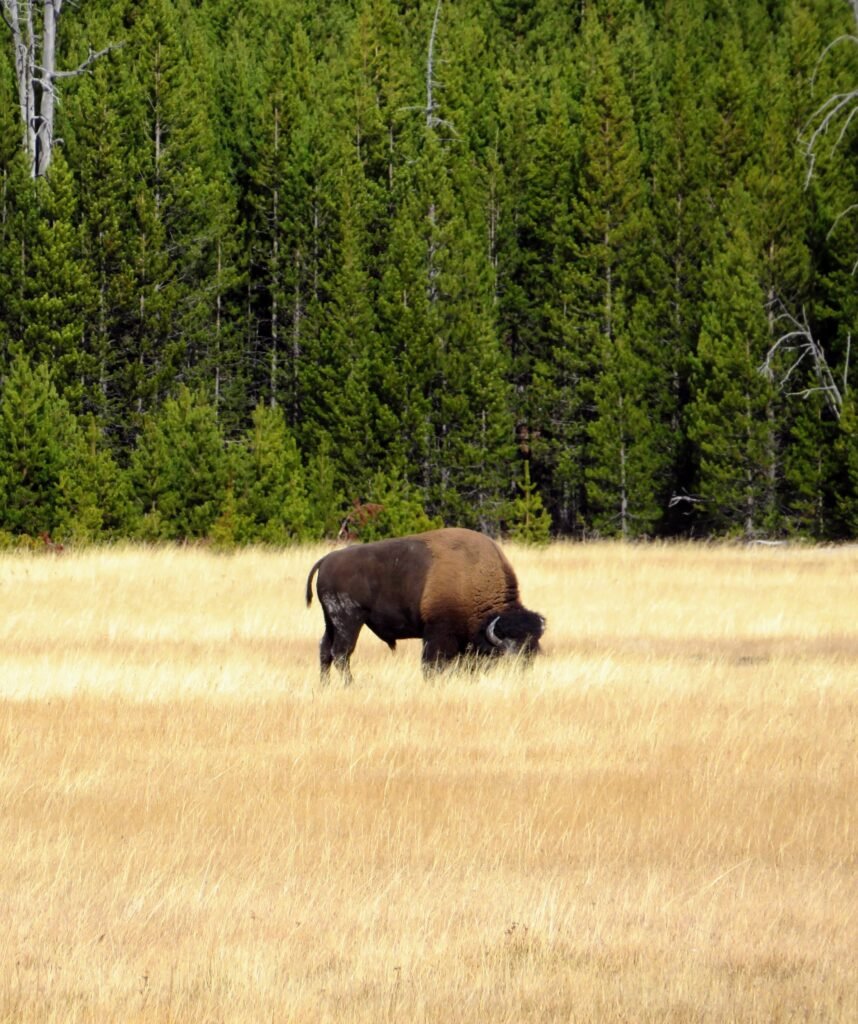
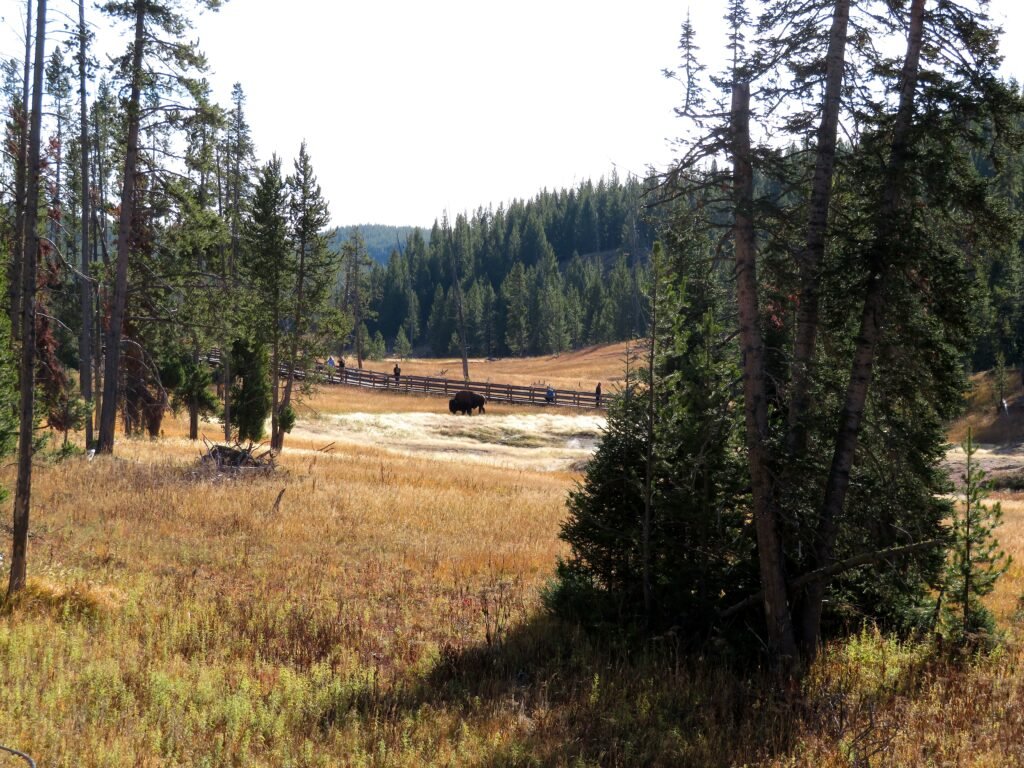
There are warnings all over the park telling you not to get too close to the animals. And for good reason. Even though they look like gentle giants, these are still wild animals who can squash you like a bug. We saw several bison over the weekend. There are over 4,500 bison living in Yellowstone.[1] It was shortly after spotting them in the field that we saw them hanging out quite near one of those observation walkways they have all throughout the park. Probably a little too close, if I’m being honest. Not so close that we could reach out and touch them (don’t do that!) Fortunately, these bison were calm and unbothered, because if they had decided to charge that walkway, I think tourists would have gone down like bowling pins.
I really loved seeing these giant beasts. They just seem to say that the wilds of America do still exist.
Norris Geyser Basin
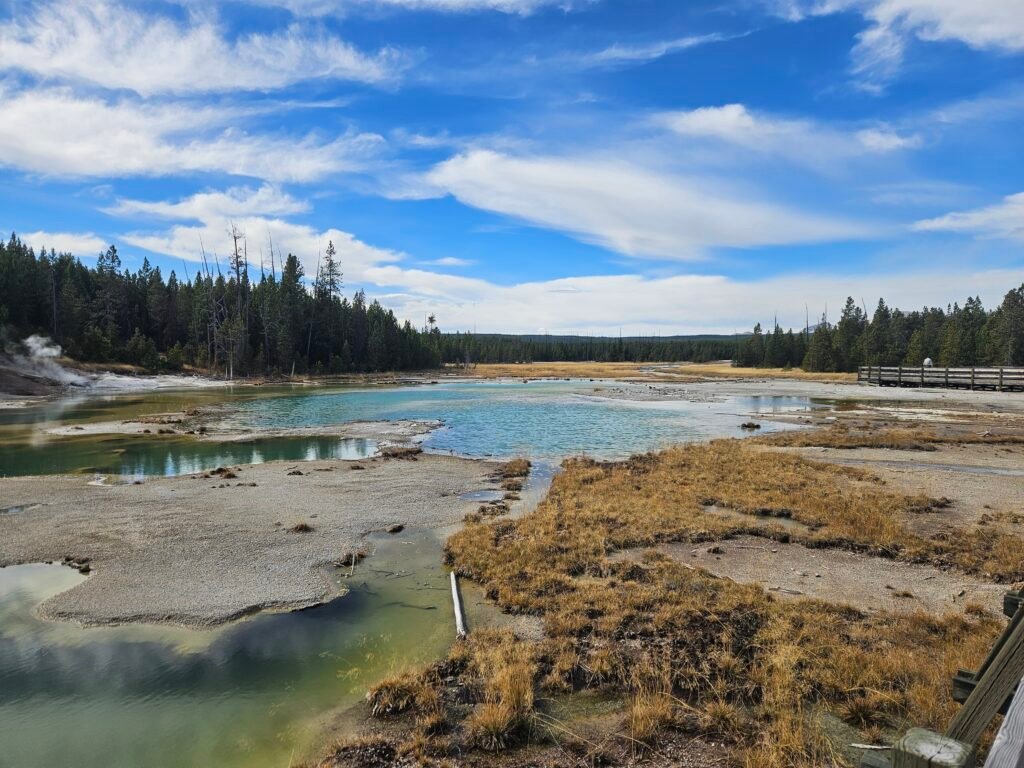
If you want to feel like you’ve been transported to another planet, or maybe another dimension, Norris Geyser Basin is the perfect backdrop. Maybe it’s just because I grew up in a desert, but I find it far stranger than Vasquez Rocks, the stand-in for many alien worlds in Star Trek.[2] And it’s strange in a different way than the bizarre, rocky formations of Goblin Valley that were used in Galaxy Quest.[3]
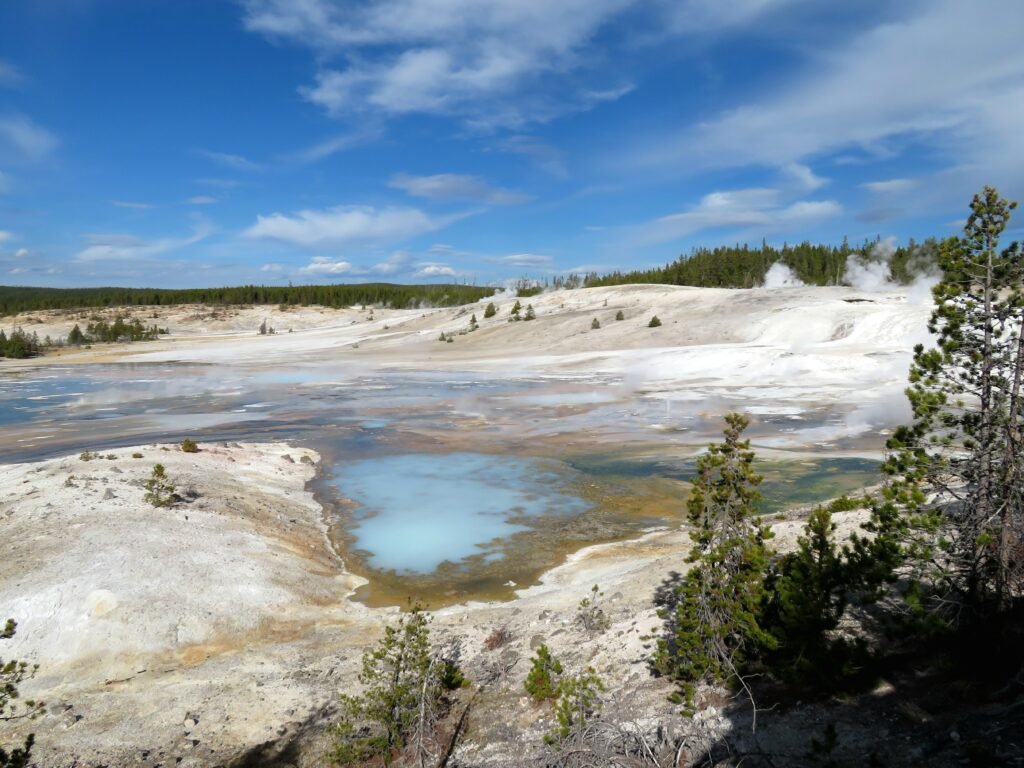
I’d say it would make the perfect landscape for a movie, but filming there would be pretty difficult since it is completely covered in delicate thermal features, most of which reach over 199°F with some underground waters getting as hot as 459°F.[4] Where would one set up a camera, much less wrestle with an alien monster?
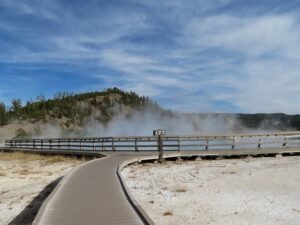
Norris Basin features two areas, Porcelain Basin and Back Basin.[5] I didn’t follow the path into the more wooded area of Back Basin. Instead, I walked down the trail into porcelain basin, a white, sandy landscape rife with emerald green and milky blue pools of water, punctuated with the skeletons of dead trees.
The wooden walkways and asphalt paths wind around vibrant thermal springs and over boiling streams, past gurgling geysers, and near billowing steam vents that smell of sulfur. One of the pathways was closed off because a steam vent (AKA fumarole) created a hazardous roadblock. Fumaroles release superheated steam that can reach up to 280°F, twice the temperature needed to cause third degree burns, so we were happy to steer clear.[6]
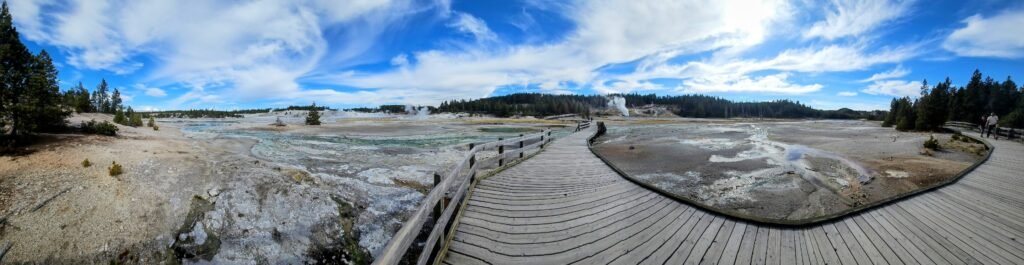
There are also mud pots. I didn’t bother to take a picture of one because I assumed it was less interesting than the colorful springs, just hot water mixed with mud. But it turns out that these are fascinating, extremely dangerous features made from water acidic enough to melt rock, causing the bubbling, muddy clay.
Some of the other waters look like they’d be cool and refreshing, the rich green a sign of algae and fish. But no. The dead grasses and falling trees around the pools are a good hint that something isn’t quite right. The bright colors of the springs are actually caused by thermophiles, microorganisms that thrive in the high temperatures of the geothermal waters.[7] When paired with a vibrant blue sky, the twisting walkways and colorful landscape are enough to make you feel like you’ve landed in wonderland.
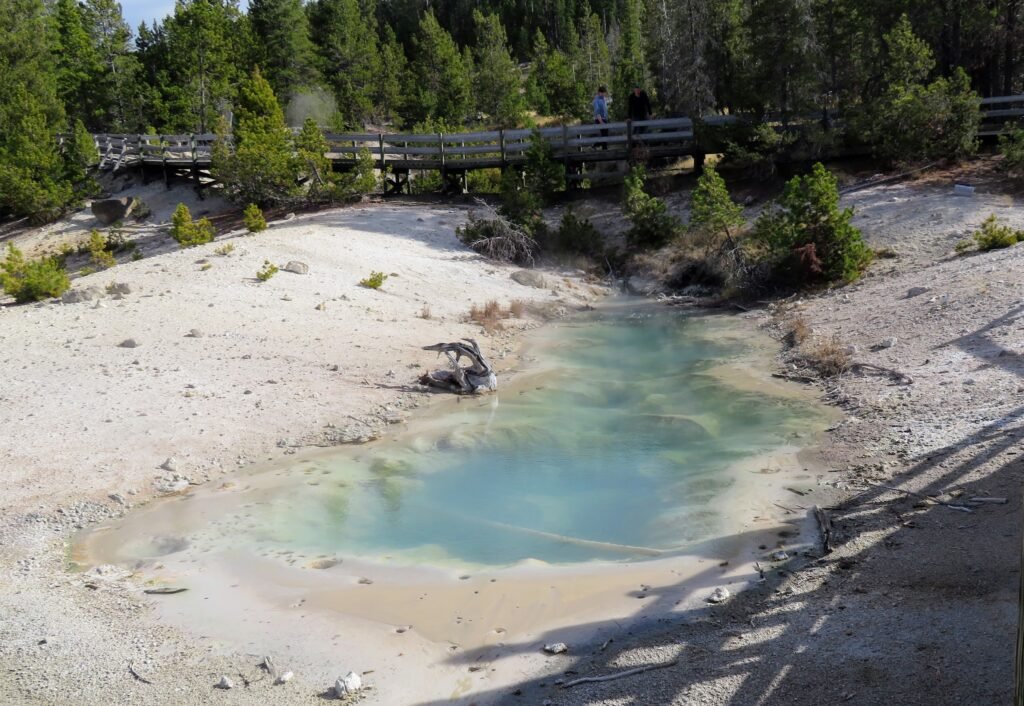
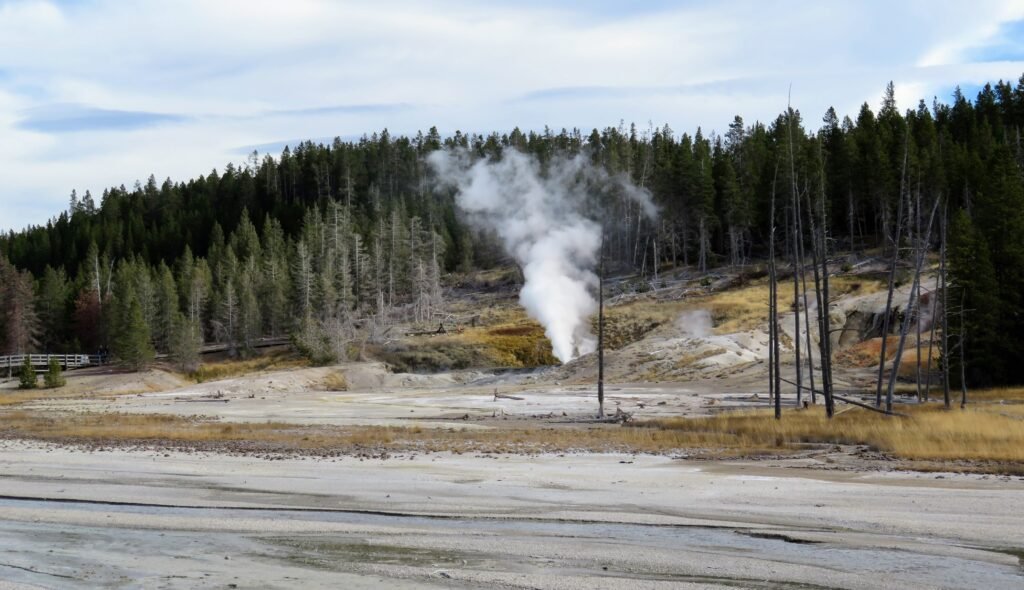
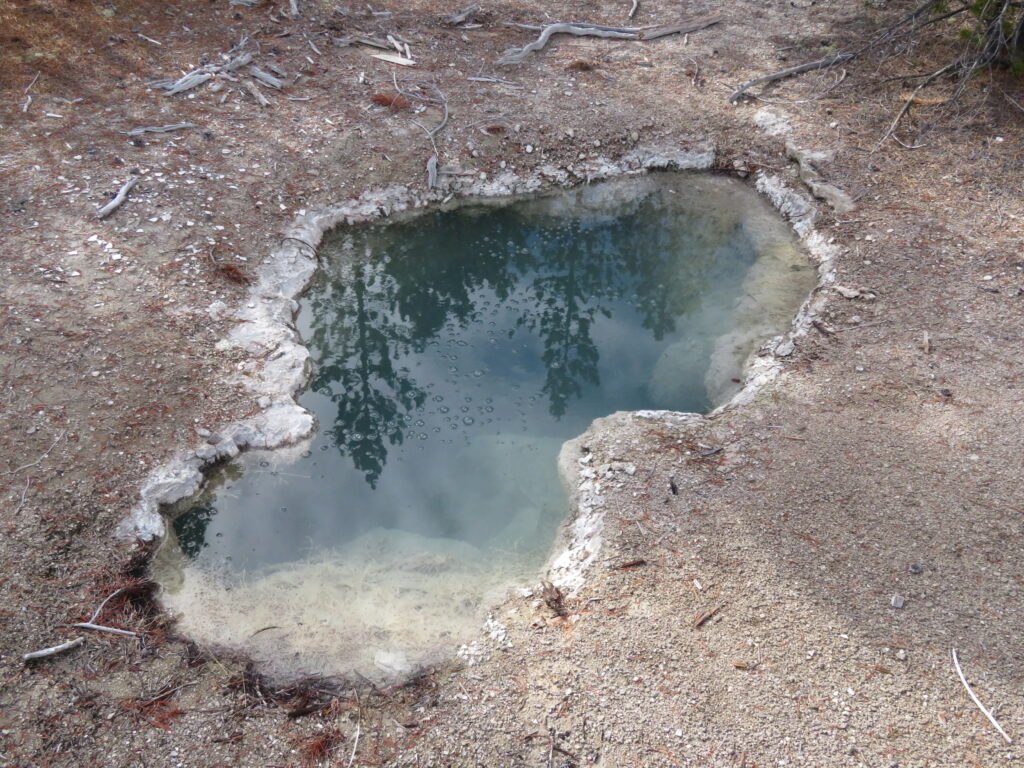
There is also an informational area that explains the temperatures of the different hot springs and what the colors of the waters signify. It’s a fairly quick stop and is great if you are interested in the science of the area.
Mammoth Hot Springs
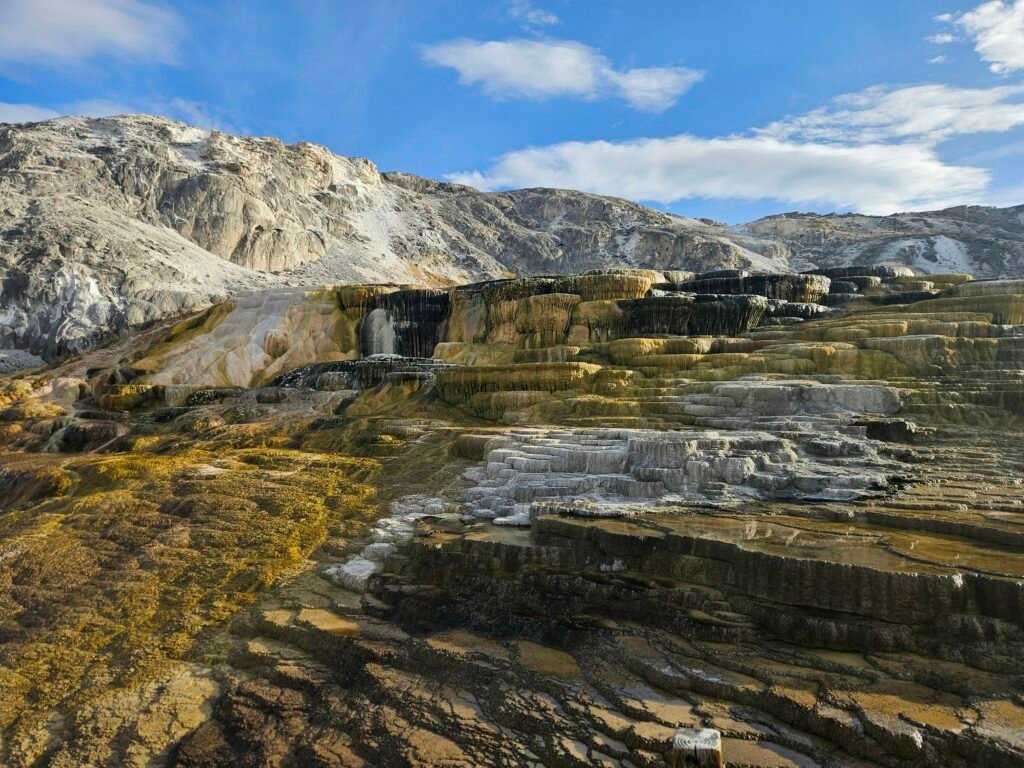
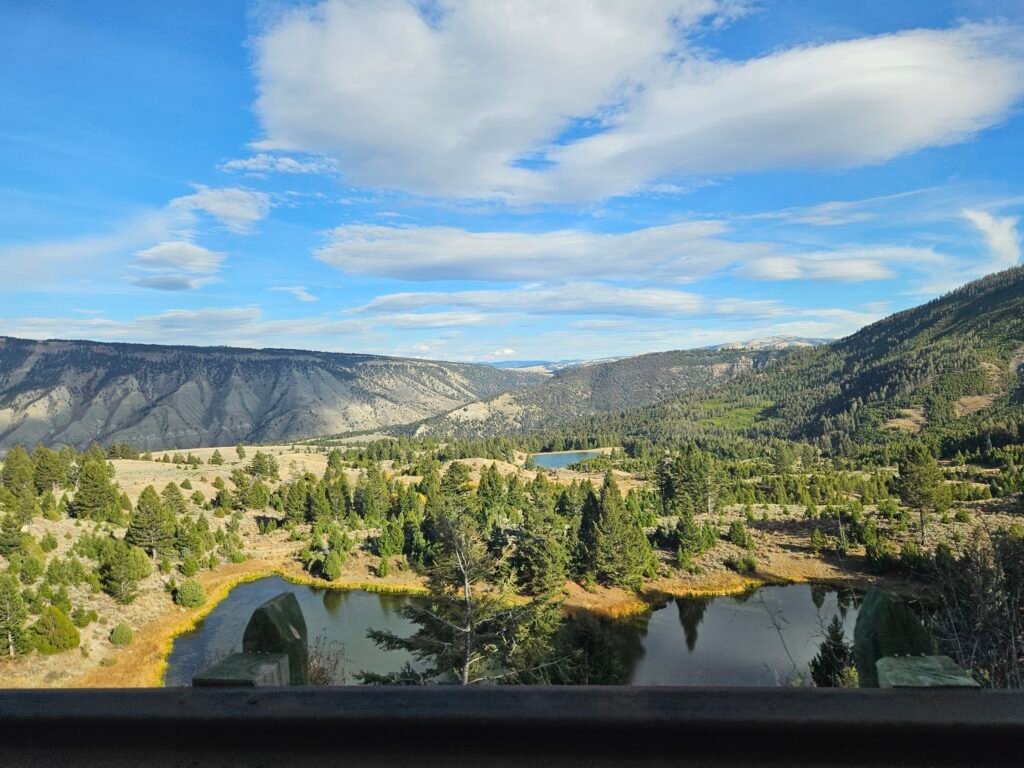
Our next stop was Mammoth Springs. To get there we had to drive down this gorgeous mountain road that opened up to reveal a beautiful valley. We also got to see the underside of the mountain bridge we were about to drive over, which I found oddly unnerving.
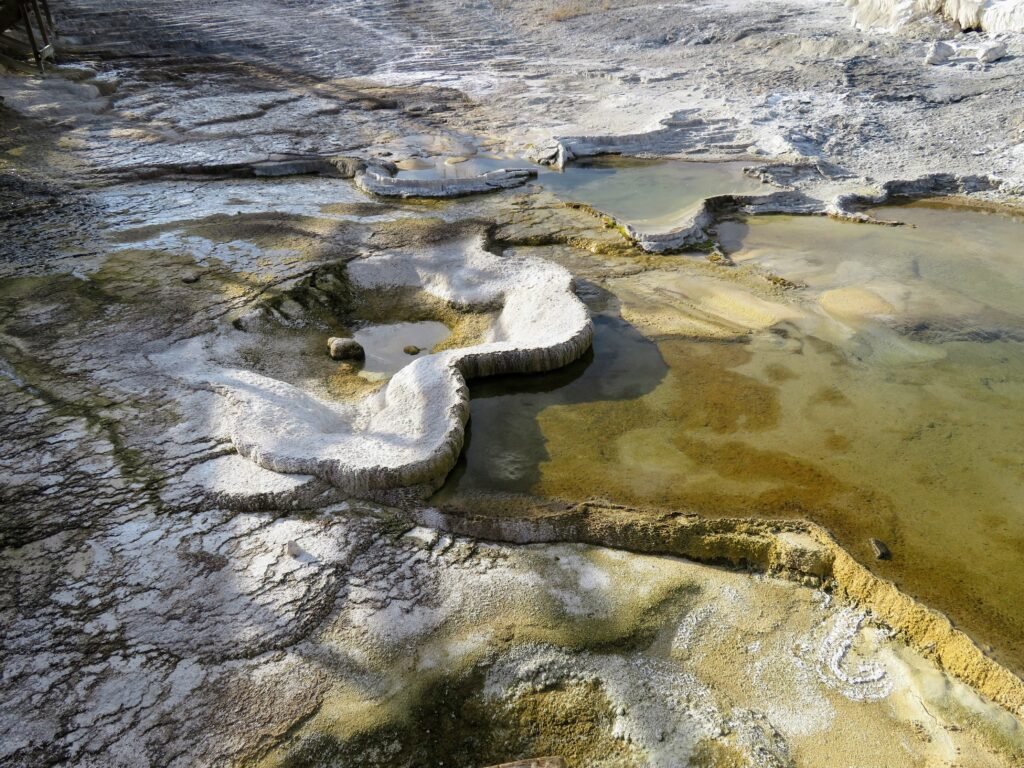
Mammoth Hot Springs is a unique experience. Natural stone steps of black, yellow, and white cascade down the side of the hill, warm spring water running over and down the edges of the rippling, rimstone pools that have formed in the tiered steps. Some of the pools feature a rich, textured surface that almost looks like coral (it isn’t). Thermophiles and other organisms add touches of color to the otherwise white stone.
Mammoth Hot Springs reminds me of a scene in Ferngully: The Last Rainforest. If you’re not familiar with this movie about fairies fighting the monster of pollution and deforestation, that’s…probably fine. But there is a beautiful scene when the main characters go into a secret cave and are playing in little rimstone pools of bioluminescent water. It makes sense that I’d draw the comparison since some people have said that Mammoth Hot springs looks like an inside-out cave.[8] Sadly, I didn’t witness either fairies or glowing waters at Yellowstone. But that’s not the point. The point is that it is magical.
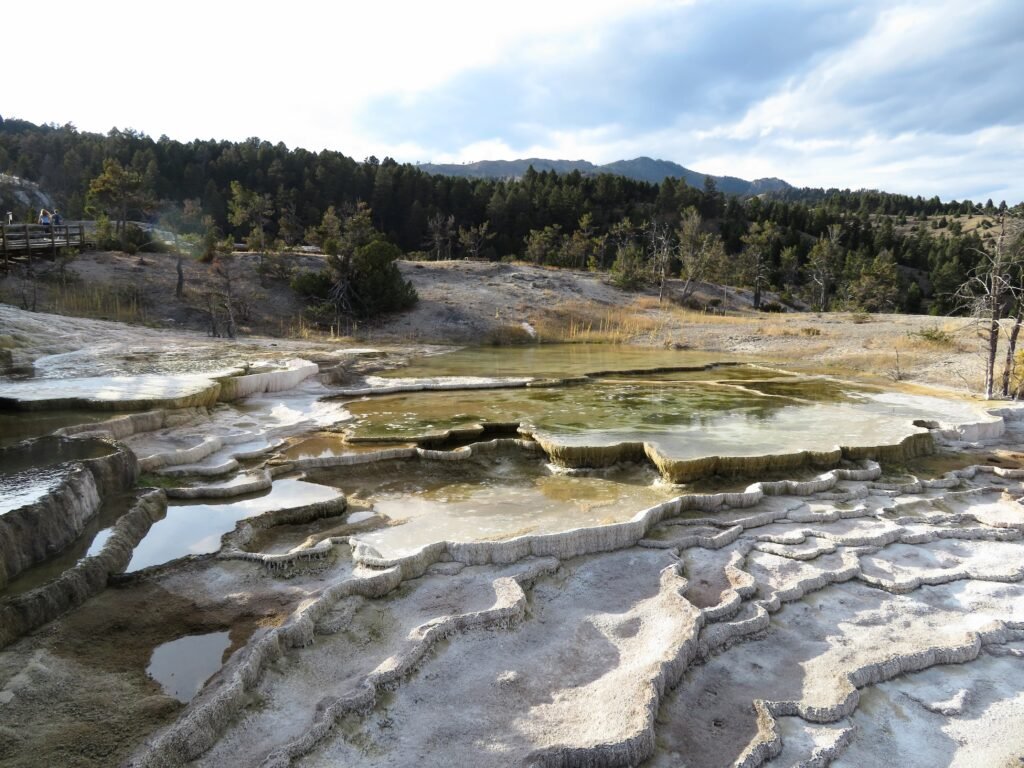
These hot spring formations are created by travertine, a white, chalky substance that has been deposited over the years.[9] This material was once collected by the Shoshone and Bannock people to be used as white paint.[10] It is created when hot, slightly acidic water dissolves calcium carbonate in underlying layers of limestone. As the water reaches the surface, the calcium carbonate is deposited in the form of travertine.[11] Though this sounds like a boring science lesson, it’s also really interesting because it means that the Mammoth Hot Springs Terraces are constantly changing because new travertine is always being deposited.
This is an area with quite a lot of stairs, ramps, and inclines. But, in my opinion, the absolutely gorgeous views make it worth the trek.
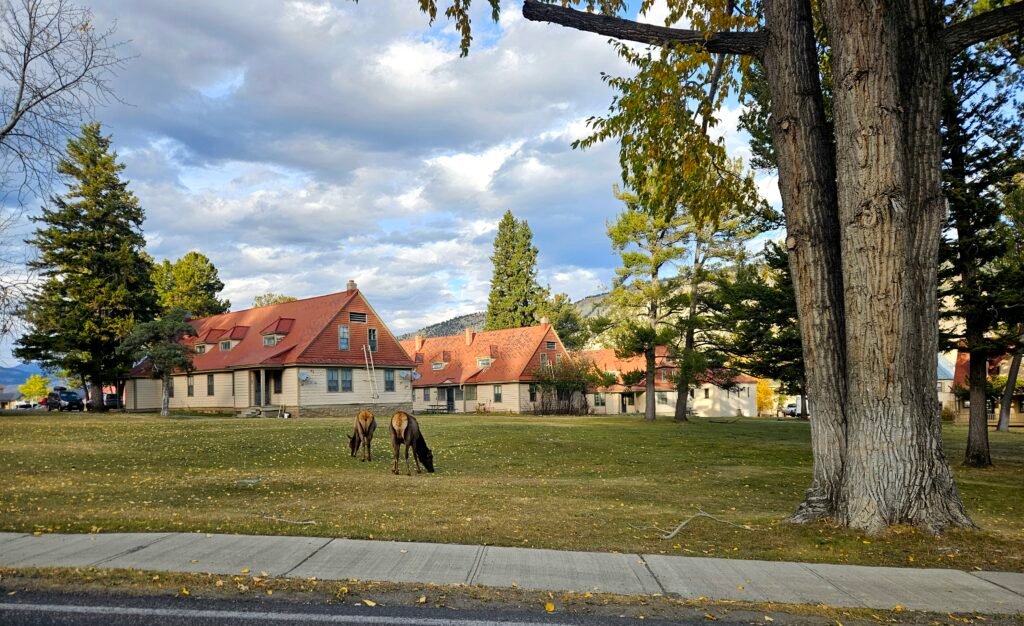
Mammoth Hot Springs are located right next to Fort Yellowstone. Originally it was used to house members of the US army who were called in to help protect and manage the park.[12] Several of those early structures currently remain.[13] This is also home to the Albright Visitor Center where you can learn about Yellowstone, including more about its history and wildlife. [14]
We also got a closeup of the elk grazing around the buildings, completely unbothered by the tourists. Once again, just a reminder to not get too close to the wild animals. Unafraid of humans does not equal tame. However, we were in a car and they were hanging out near the road, so we were pretty much as responsible as we could be.
Petrified Tree Near Tower Junction
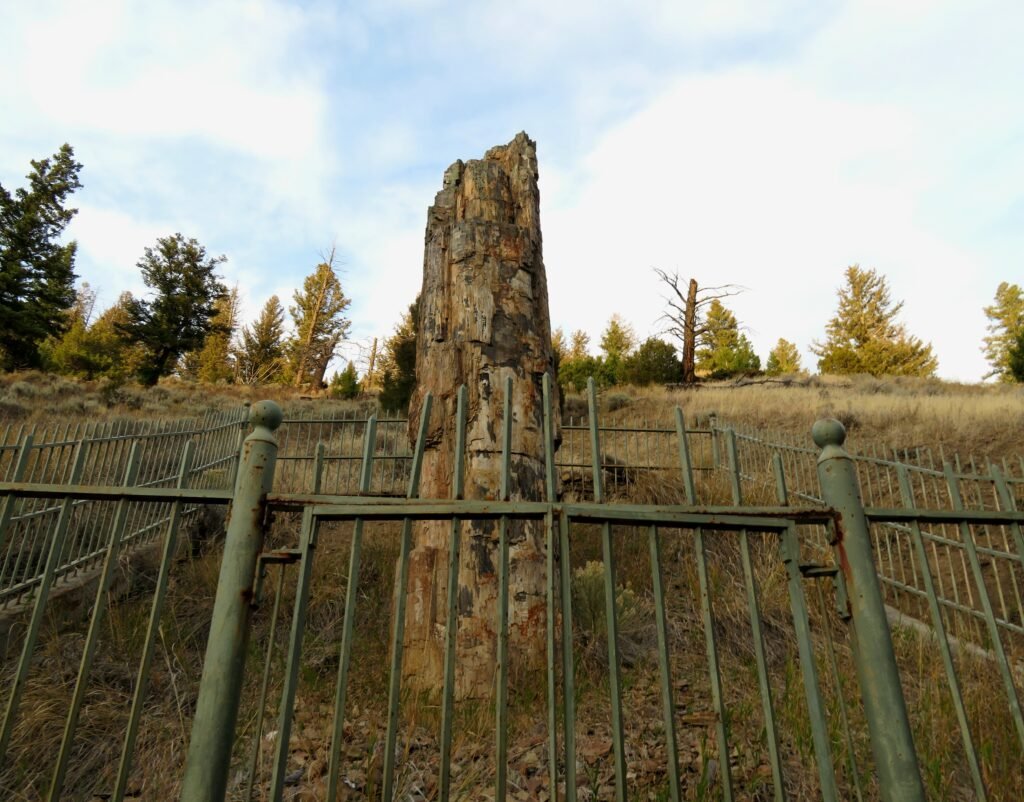
The next place we went was the petrified tree. I wanted to go here because I like rocks and fossils, I like trees, and I like science. Yellowstone has one of the largest deposits of petrified trees anywhere in the world.[15]
These trees serve as reminders of a climate that Yellowstone no longer supports.[16] This particular tree is a redwood that stands on the Absaroka volcanoes. Millennia ago, the volcano melted mountain snow and ice, and the flowing waters picked up mud and debris to become a slurry that poured over the prehistoric forest.[17] The trees were covered in this debris, and the silicate and calcite in the volcanic ash water clogged the tubes that transport water throughout the trees, creating a unique petrification process. Unlike other petrified forests where minerals usually replace all of the cells, some of the organic matter and cells were preserved.[18] Which is pretty cool, scientifically speaking.
If you are a geologist, this site should definitely appeal to you. However, if you’re not and you want to skip this landmark, you probably can. It’s a fairly short and easy hike from the road, and every place in Yellowstone is beautiful. But this site isn’t exactly a showstopper. It looks like a broken tree inside a fence. It’s really the science and the history that make it interesting. However, I believe there may be some nice hikes around the tree if you’d like to explore.
Random Roadsides
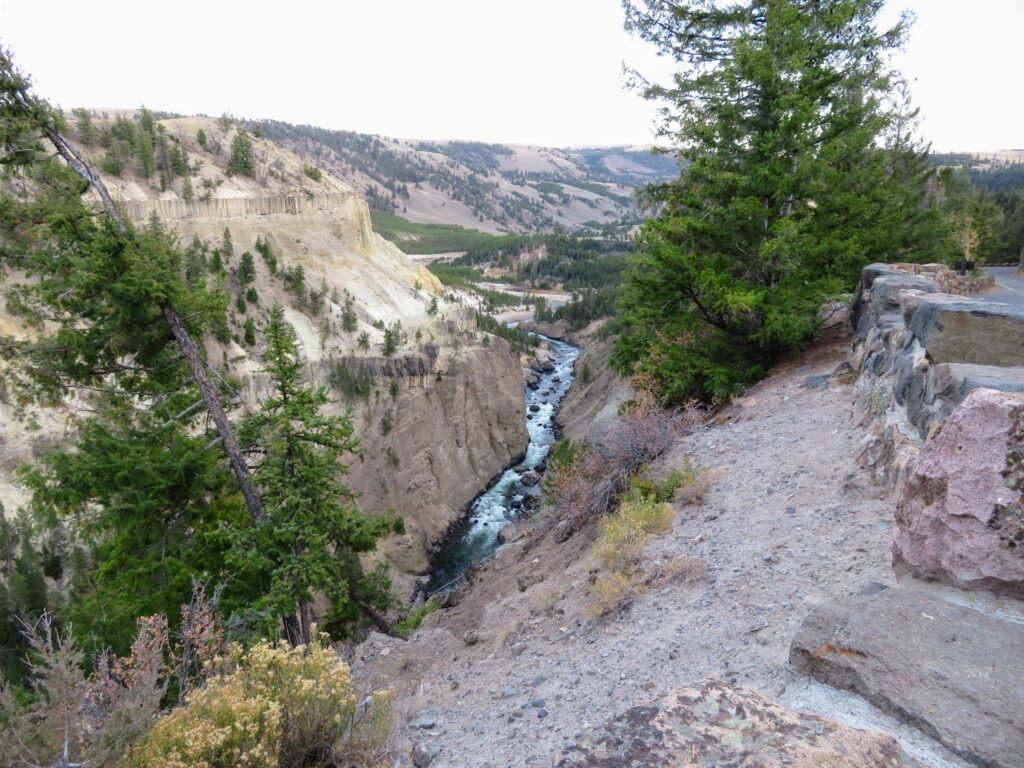
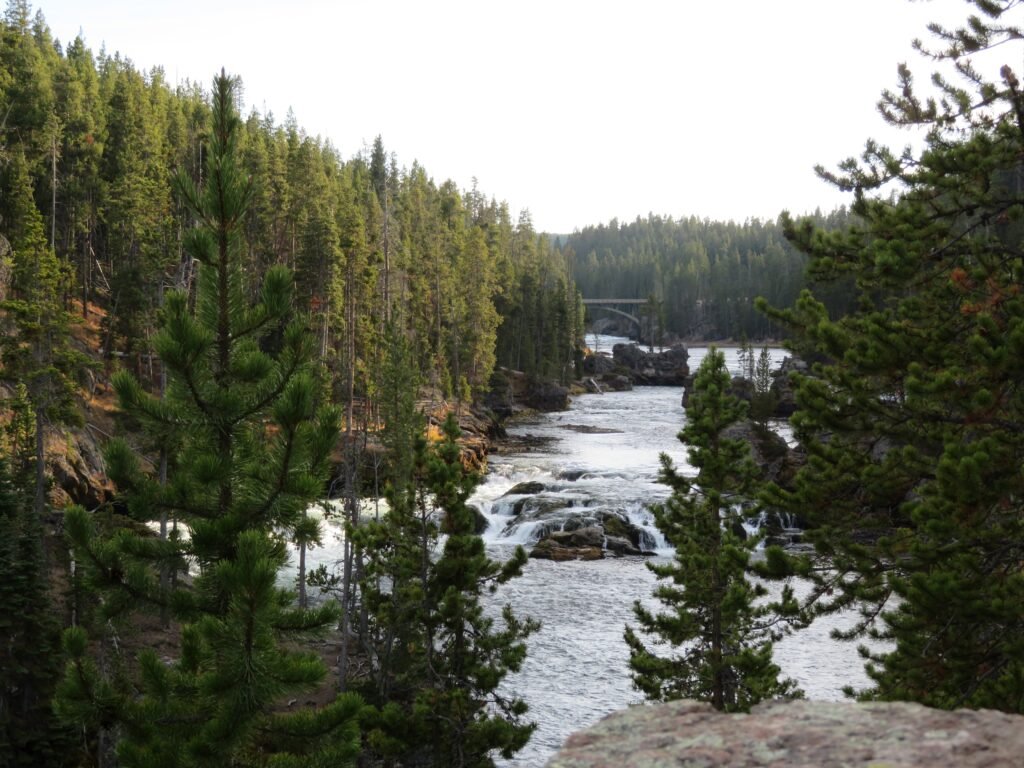
Even just driving around to exit the park led to some truly beautiful scenery. We came across this fantastic overlook where we got a gorgeous view of the Yellowstone River. We also got a closeup of a raven and a chipmunk. I’d definitely recommend stopping at the random scenic spots and overlooks as you come across them. They are usually less crowded than the hot springs, and they really open up the beauty and grandeur of the entire park.
As it was edging towards night, we saw a lot more animals among the trees and crossing the road including goats, deer, elk, and more bison. We often had to stop for animal crossings. Though wild animals can walk by and dart into the road at any time, we saw a definite uptick at dusk, so you’ll want to keep an extra eye on the sides of the roads if you’re driving through the park in the evening.
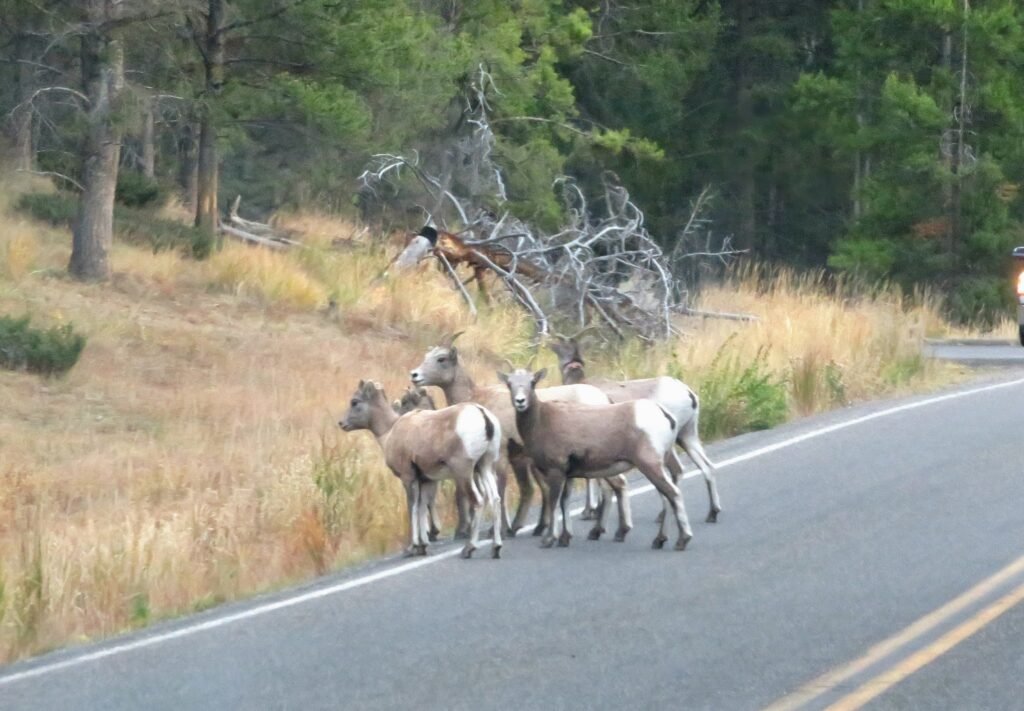
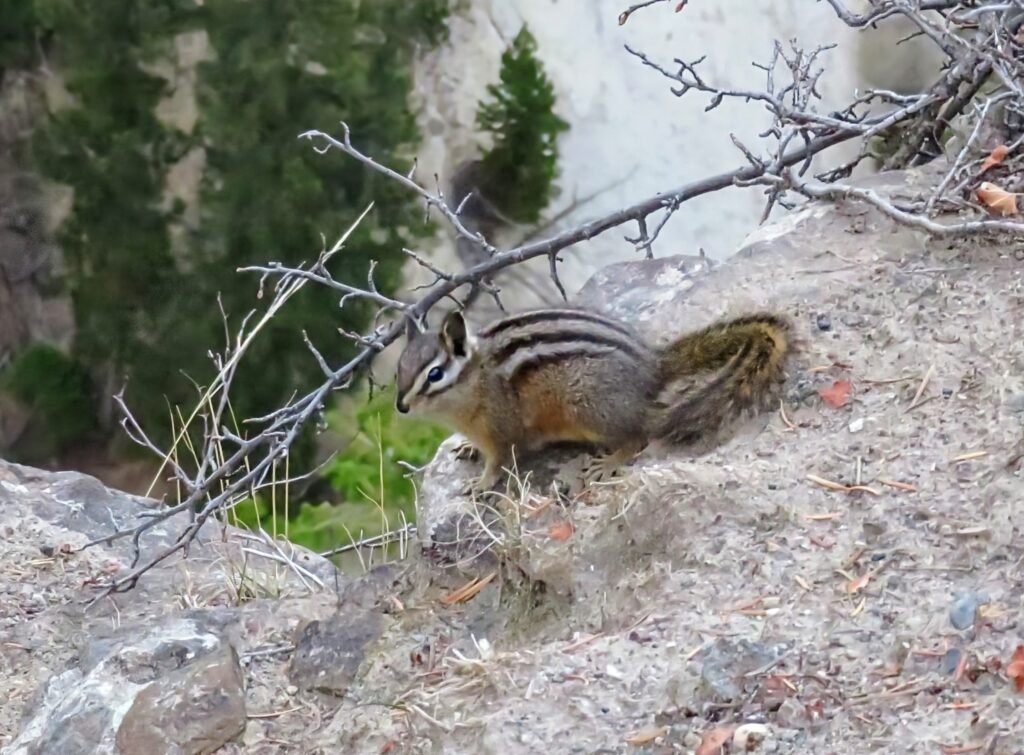
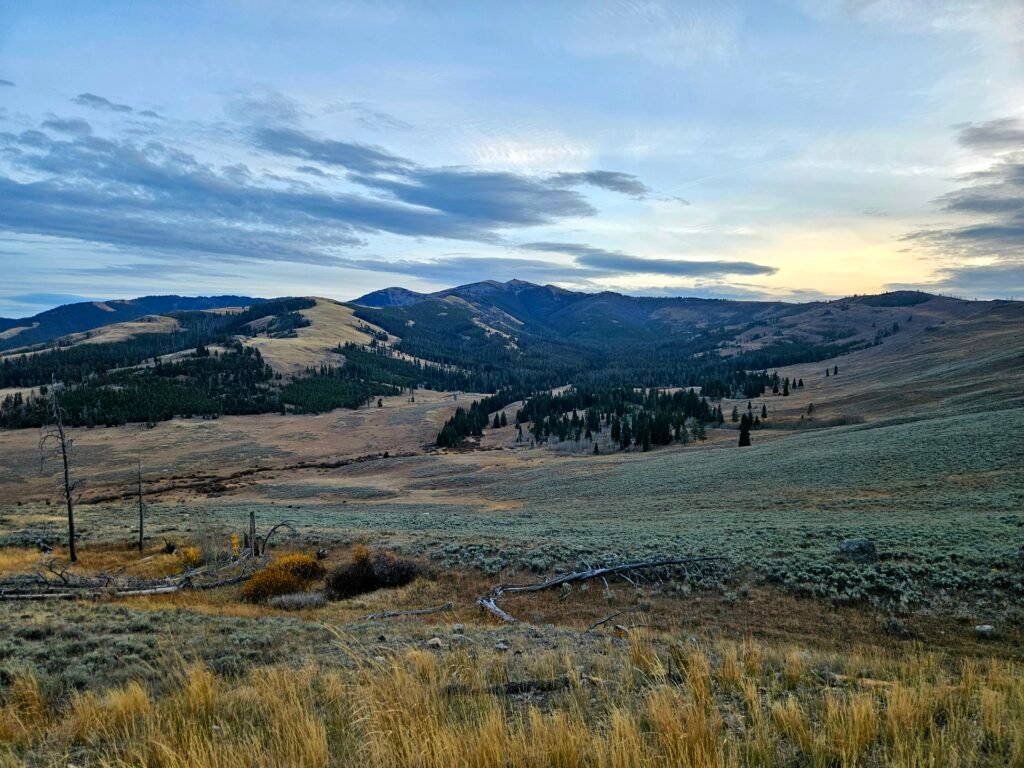
Though I loved my walks around Yellowstone, even just the drive is gorgeous. Stopping to watch the sun set behind the hills and rolling plains allows you to soak in the wild beauty of the west. With the warm glow of the fading autumn light, we left the park and finished our first day at Yellowstone.
[1] Bison Ecology – Yellowstone National Park (U.S. National Park Service). (n.d.). https://www.nps.gov/yell/learn/nature/bison.htm#:~:text=Number%20in%20Yellowstone,in%20late%20April%20or%20May.
[2] Lewis, R. (2016, September 8). How Vasquez Rocks, L.A.’s onetime outlaw hideout, became “Star Trek’s” favorite alien landscape – Los Angeles Times. Los Angeles Times. https://www.latimes.com/entertainment/tv/la-et-st-star-trek-50-vasquez-rocks-20160829-snap-story.html
[3] Goblin Valley State Park | Utah.com. (n.d.). Utah.com. https://www.utah.com/destinations/state-parks/goblin-valley-state-park/
[4]Norris Geyser Basin – Yellowstone National Park (U.S. National Park Service). (n.d.). https://www.nps.gov/yell/planyourvisit/norrisplan.htm
[5] Norris Geyser Basin – Yellowstone National Park (U.S. National Park Service). (n.d.). https://www.nps.gov/yell/planyourvisit/norrisplan.htm
[6] Hydrothermal features – Yellowstone National Park (U.S. National Park Service). (n.d.). https://www.nps.gov/yell/learn/nature/hydrothermal-features.htm
[7] Hydrothermal features – Yellowstone National Park (U.S. National Park Service). (n.d.). https://www.nps.gov/yell/learn/nature/hydrothermal-features.htm
[8] Holden, C. (2019b, December 10). Mammoth hot springs looks like an Inside-Out cave. Yellowstone National Park Trips. https://www.yellowstonepark.com/things-to-do/geysers-hot-springs/mammoth-hots-springs-inside-cave/?scope=anon
[9] Holden, C. (2019, December 10). Mammoth hot springs looks like an Inside-Out cave. Yellowstone National Park Trips. https://www.yellowstonepark.com/things-to-do/geysers-hot-springs/mammoth-hots-springs-inside-cave/?scope=anon
[10] Mammoth Hot Springs Trails (U.S. National Park Service). (n.d.). https://www.nps.gov/thingstodo/yell-mammoth-hot-springs-trails.htm
[11] Mammoth Hot Springs – Old Faithful Virtual Visitor Center. (n.d.). https://www.nps.gov/features/yell/ofvec/exhibits/treasures/thermals/hotspring/mammoth.htm
[12] Fort Yellowstone – Yellowstone National Park (U.S. National Park Service). (n.d.). https://www.nps.gov/yell/learn/historyculture/fort-yellowstone.htm
[13] Fort Yellowstone – Yellowstone National Park (U.S. National Park Service). (n.d.). https://www.nps.gov/yell/learn/historyculture/fort-yellowstone.htm
[14] Albright Visitor Center – Yellowstone National Park (U.S. National Park Service). (n.d.). https://www.nps.gov/yell/planyourvisit/albright-visitor-center.htm
[15] Feeling petrified! Evidence of Yellowstone’s distant volcanic past found in rocks and trees. (n.d.). USGS. https://www.usgs.gov/observatories/yvo/news/feeling-petrified-evidence-yellowstones-distant-volcanic-past-found-rocks
[16] Fitzgerald, E. (2019, September 24). Yellowstone’s Petrified Trees. Yellowstone Forever. https://www.yellowstone.org/yellowstones-petrified-trees/
[17] Feeling petrified! Evidence of Yellowstone’s distant volcanic past found in rocks and trees. (n.d.-b). USGS. https://www.usgs.gov/observatories/yvo/news/feeling-petrified-evidence-yellowstones-distant-volcanic-past-found-rocks
[18] Fitzgerald, E. (2019c, September 24). Yellowstone’s Petrified Trees. Yellowstone Forever. https://www.yellowstone.org/yellowstones-petrified-trees/