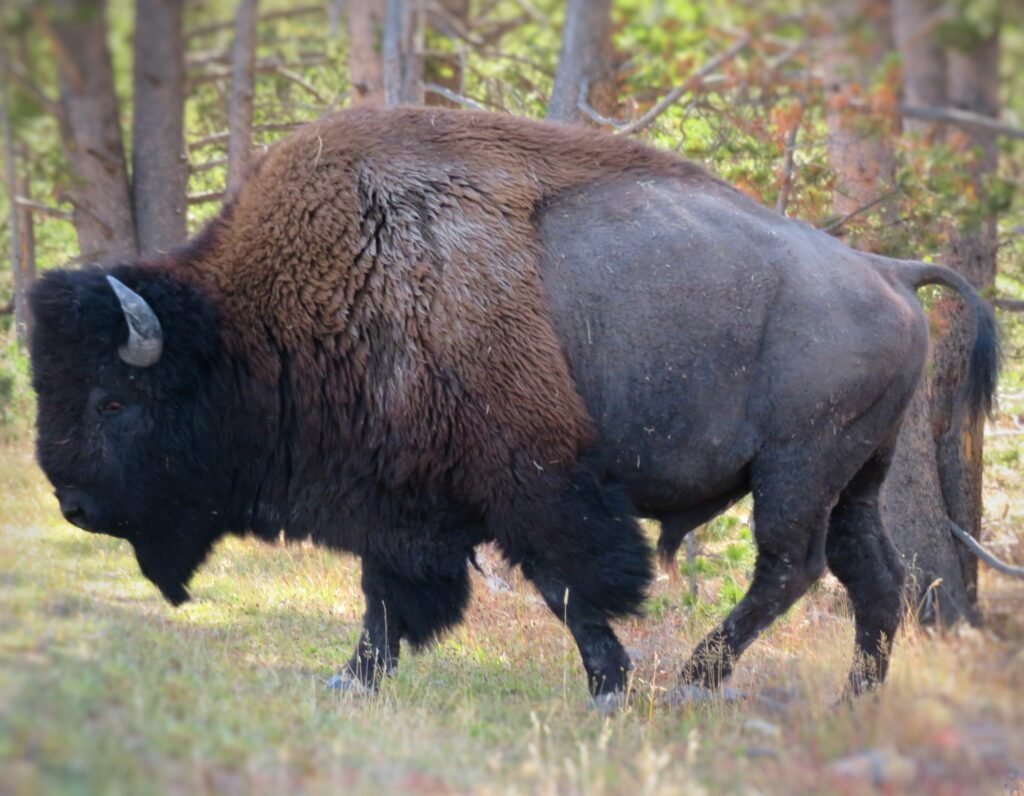
Day 2 in Yellowstone started as an adventure. Shortly after we entered the park, we had to stop our drive because this very large buffalo was preparing the cross the road.
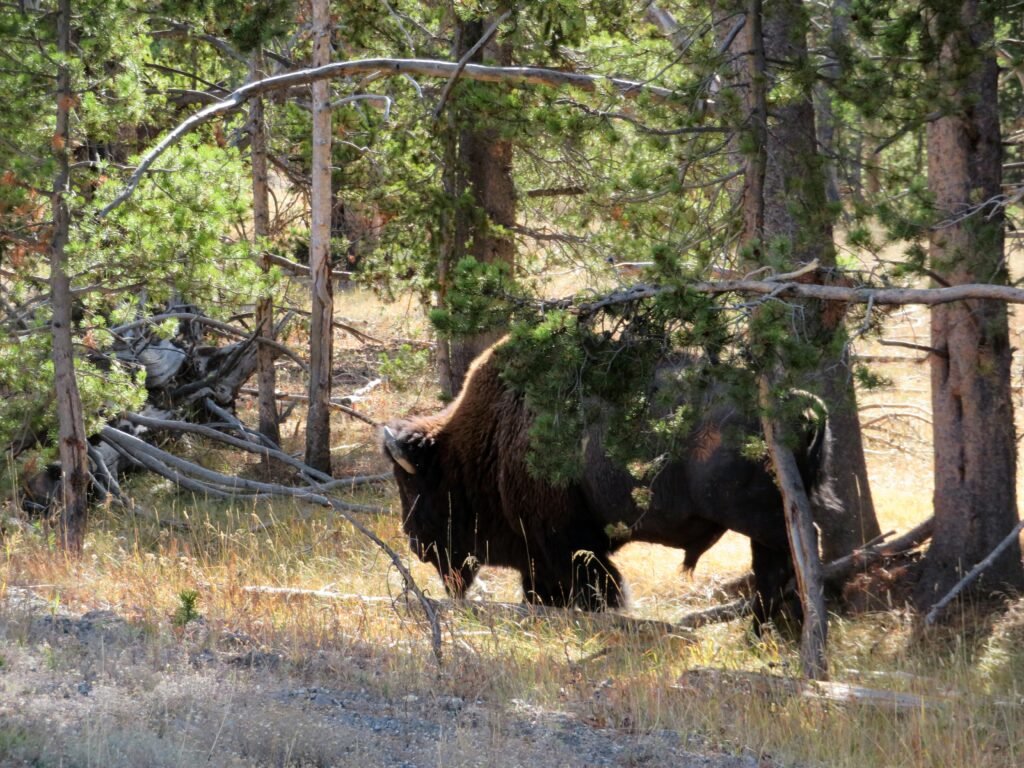
In Yellowstone or…anywhere really, buffalo get the right of way. Which is why several cars stopped and waited for him to cross. However, there was a driver a few cars behind us who was a teensy bit impatient. He decided to zoom around the stopped cars by going into the oncoming traffic lane. Don’t worry, there was no collision with the bison or with another car! But it still wasn’t a smart move.
Here’s the thing. Bison are big. The average male bison stands about 6 feet tall and weighs up to 2000 pounds.[1] If the driver had hit that thing, his big truck would have been totaled. You get into a fight with a bison—even in a car—that bison may not win, but he sure as heck ain’t gonna lose.
Fortunately, the driver was lucky (even if he probably didn’t learn his lesson about driving safely) and no one was hurt. He did succeed in herding the bison back to our side of the road. And, when it chose to wander back, it did so right in front of our car, briefly turning to face us. I did not get a picture of this, because my soul briefly left my body as I wondered if he was going to charge our car. He seemed like he was thinking about it.
Thankfully, he didn’t. But we got a closer view of the wildlife than we were expecting.
Lessons here:
- Wildlife crossings happen frequently at Yellowstone.
- If traffic is stopped, trust that it’s for a reason.
- Don’t hit a bison. It will not end well.
- Drive responsibly.
Old Faithful
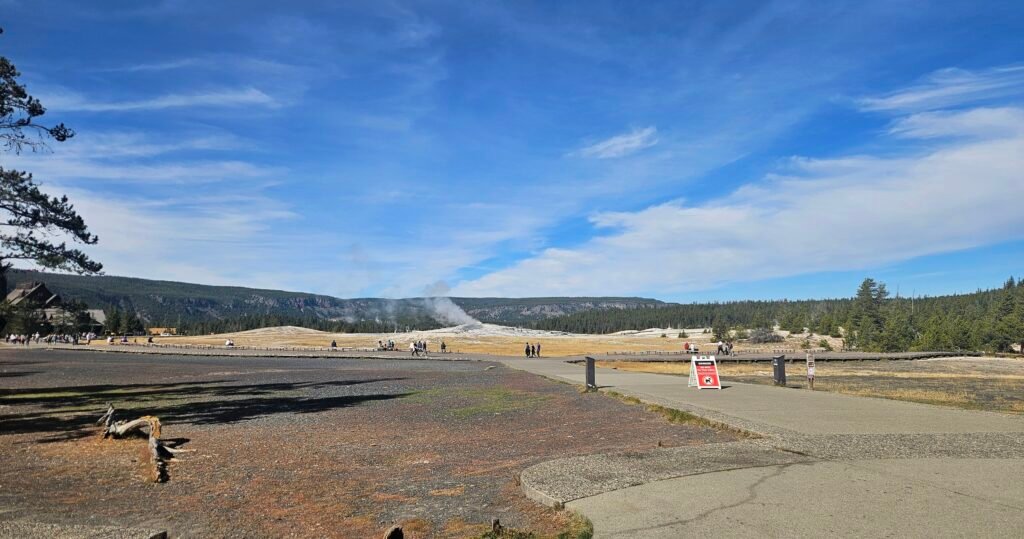
After our run-in with the buffalo, we headed to Old Faithful, arguably the most famous attraction in Yellowstone. Though I was under the impression that you could practically set your watch by this geyser, there’s a lot of variation in the time. Old Faithful erupts roughly every 50 to 127 minutes with the average time between erruptions being about 90 minutes.[2] Basically, it’s more predictable than most geysers, but there’s still a lot of guesswork involved.
Fortunately, there are a couple of locations where the kind professionals at Yellowstone list the last eruption time, including inside the Old Faithful Visitor and Education Center. A store, a restaurant, and the famous Old Faithful Inn are also nearby if you want to buy some souvenirs, or if you just get peckish.
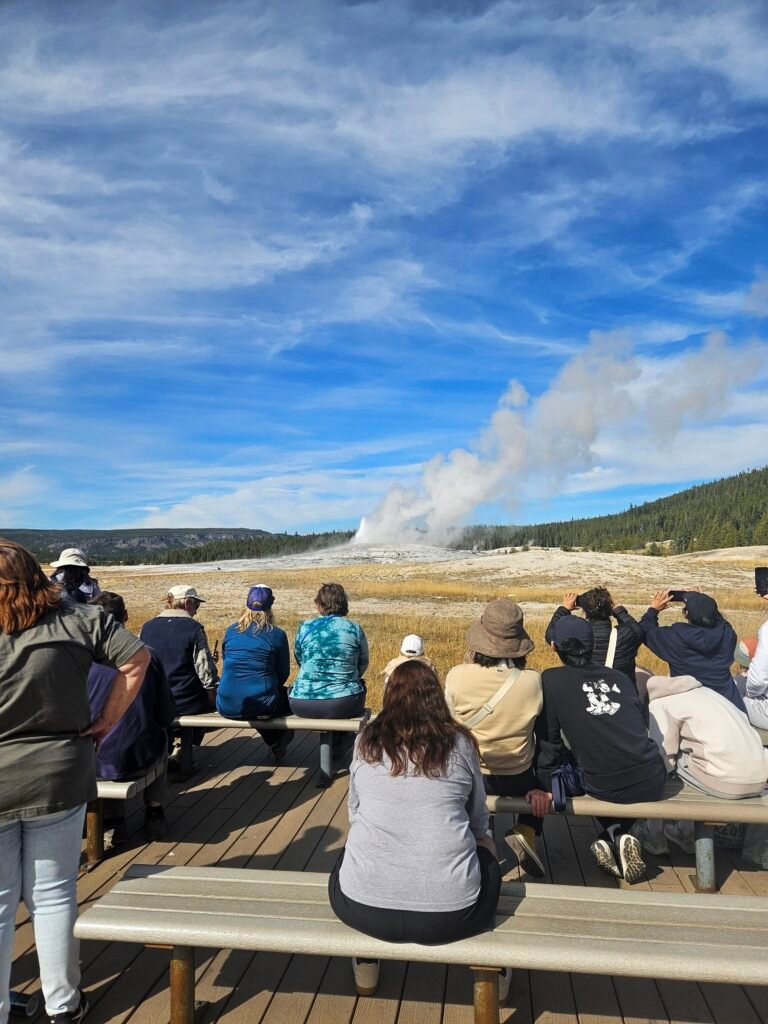
Old Faithful itself looks like a white mound that sits on a barren landscape with walking paths surrounding its outer perimeter. Benches around the geyser offer prime viewing real-estate but they fill up quickly so don’t hesitate to grab a seat. By the time the geyser went off, it was standing room only. Folks started gathering for the eruption about 30 minutes before it went off.
Old Faithful does have a bit of a preshow. Bursts of steam and tiny burbles of water fooled people (including myself) into thinking that the main event was starting. It was funny listening to visitors starting to ooh and ahh at the false starts, only to be underwhelmed by what was essentially tiny little gurgles. But the main event was much more impressive.
Eventually, a fountain of water burst from the ground, reaching higher and higher and continuing in spurts for several minutes. The geyser blasts boiling hot streams of water into the air to a height of 106 to 184 feet.[3] What we witnessed was probably on the lower end of that spectrum, but there’s still something very exciting about this natural, danger fountain. It can be a long wait for a relatively short show (maybe 5 minutes of so), but Old Faithful is a great place to sit, enjoy the sunshine, and indulge in that human need to see stuff get blown sky-high.
Old Faithful Inn
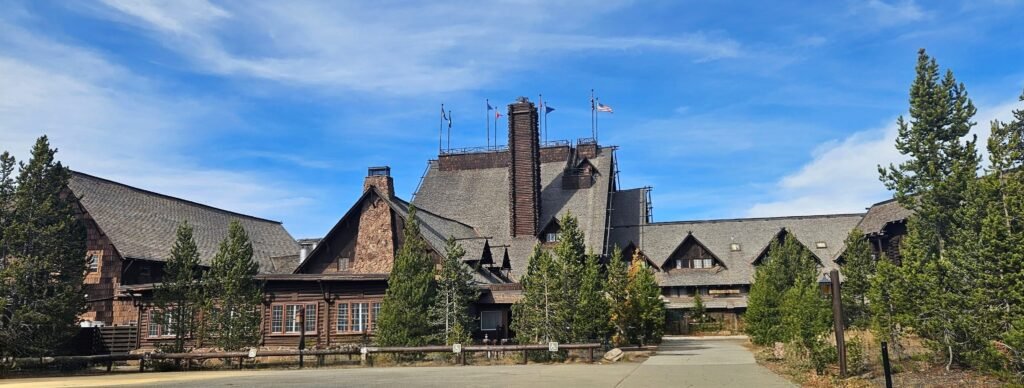
After watching Old Faithful do its thing, we walked around, bought some souvenirs, and then took a peek inside the Old Faithful Inn. It was such an interesting building from the outside that we had to walk inside and take a look around. With all of the stone, woodwork, and log-style staircases, something about the hotel looks almost animated, especially in pictures.
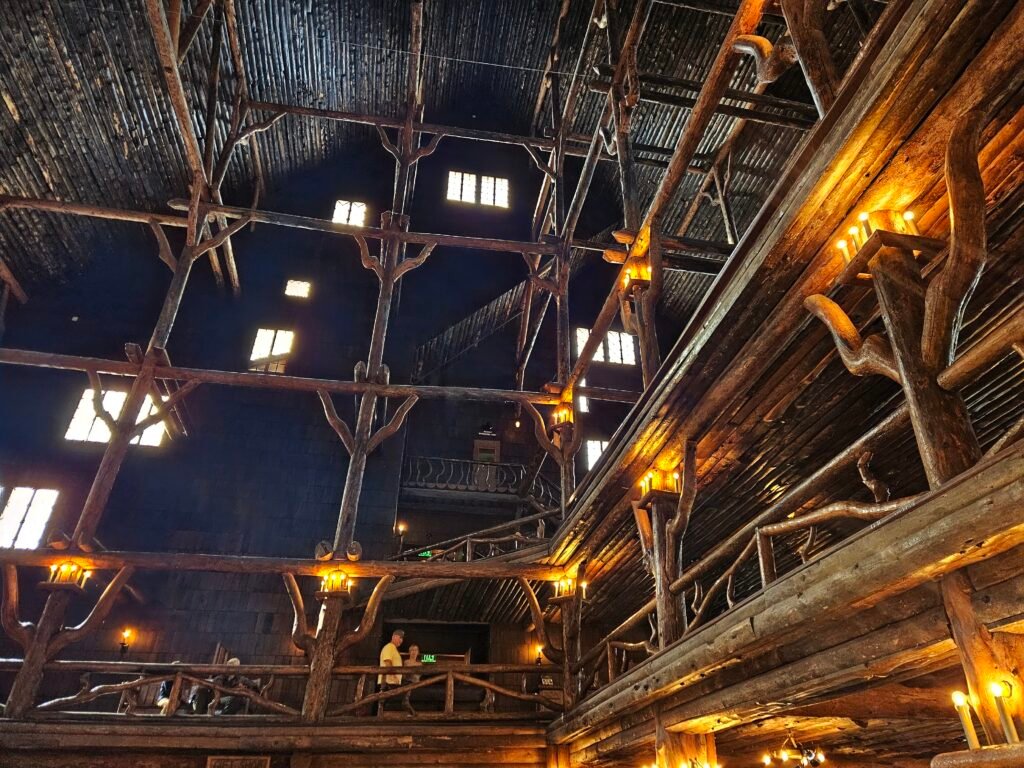
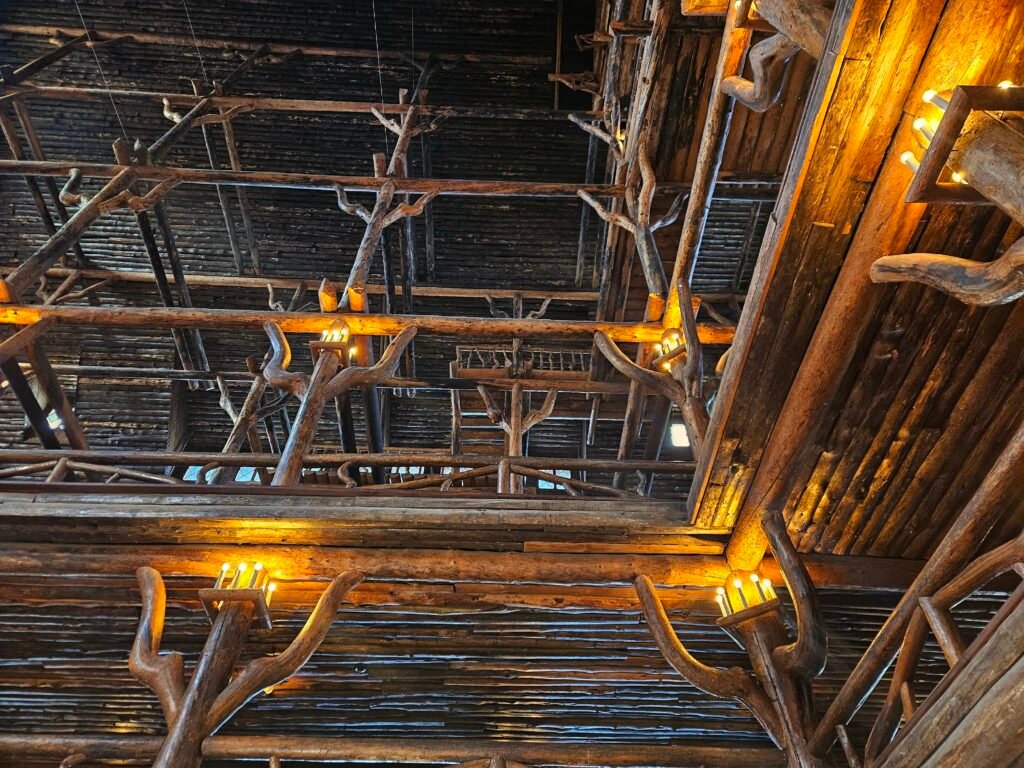
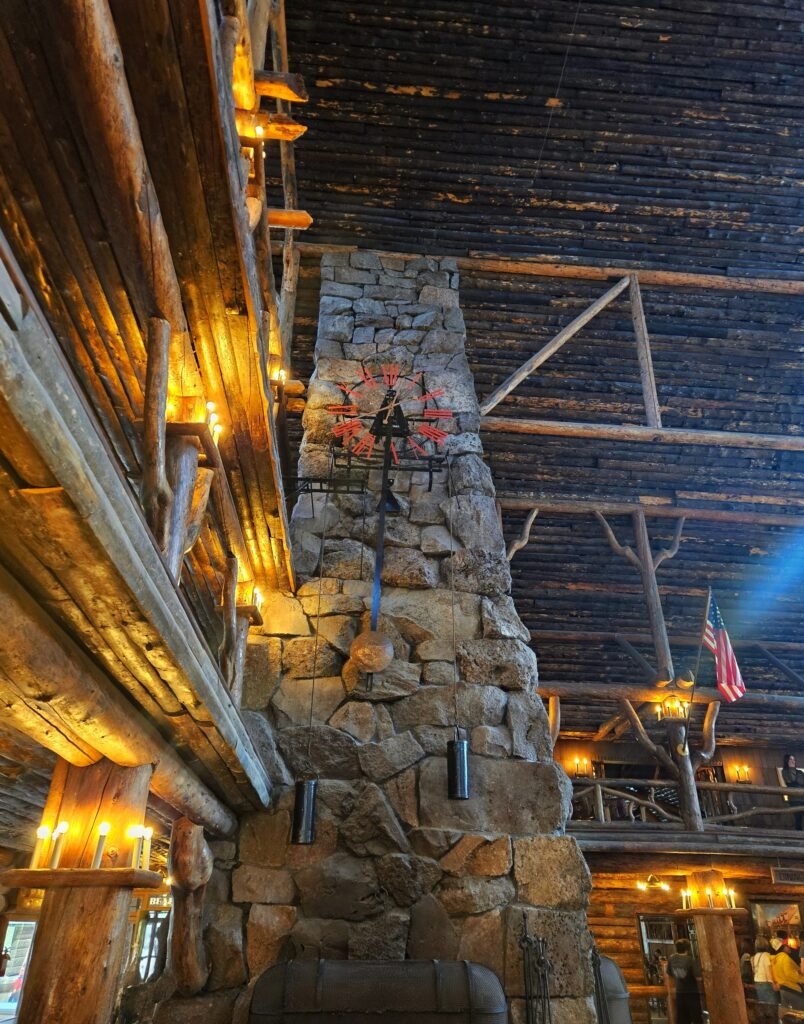
The centerpiece of the inn is a large stone fireplace with a unique pendulum clock. To me, it looks like a mid-century marvel, but the clock was originally made somewhere between 1903 and 1904 by a Livingston blacksmith.[4] You can also spy the crow’s nest that features in one of the haunted legends of the hotel. You can read about it here.
The hotel is also a good place to get a bathroom break. I didn’t take a picture inside the bathroom because that would be weird, but it had an old-timey elegance that felt very 1920’s upper crust. And I always appreciate knowing where to find a clean bathroom. I would definitely recommend getting a look at this historic building.
Midway Geyser Basin
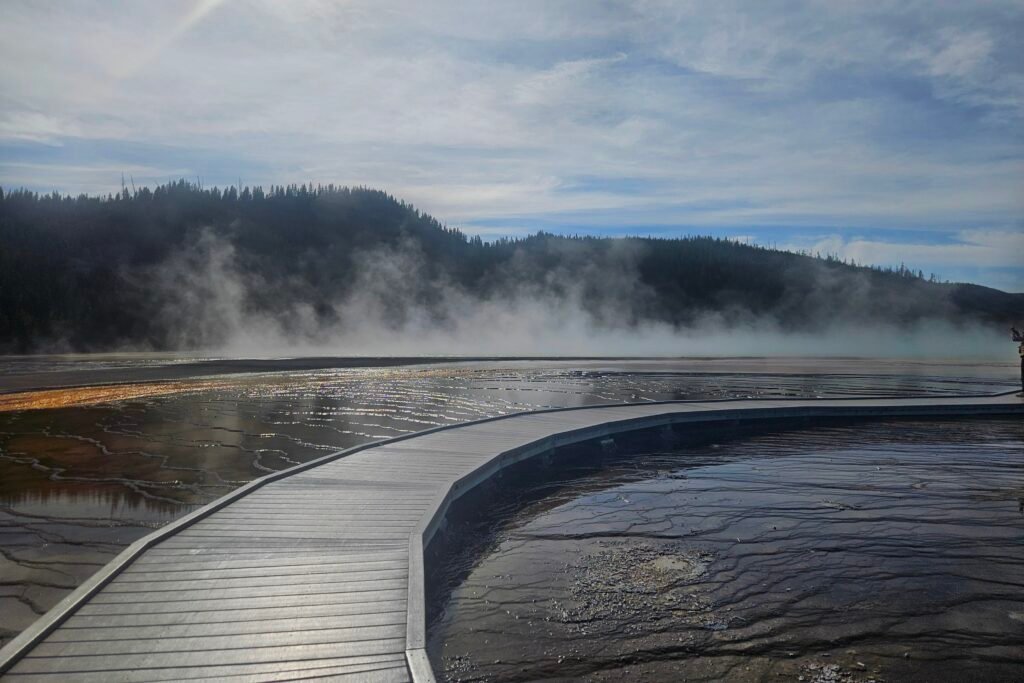
Our next stop was Midway Gester Basin, and it was one of my favorite stops in Yellowstone. The basin is a short drive from Old Faithful, and it has four main attractions: the smaller Opal and Turquoise pools, the much larger Excelsior Geyser Crater, and the famous Grand Prismatic Spring.
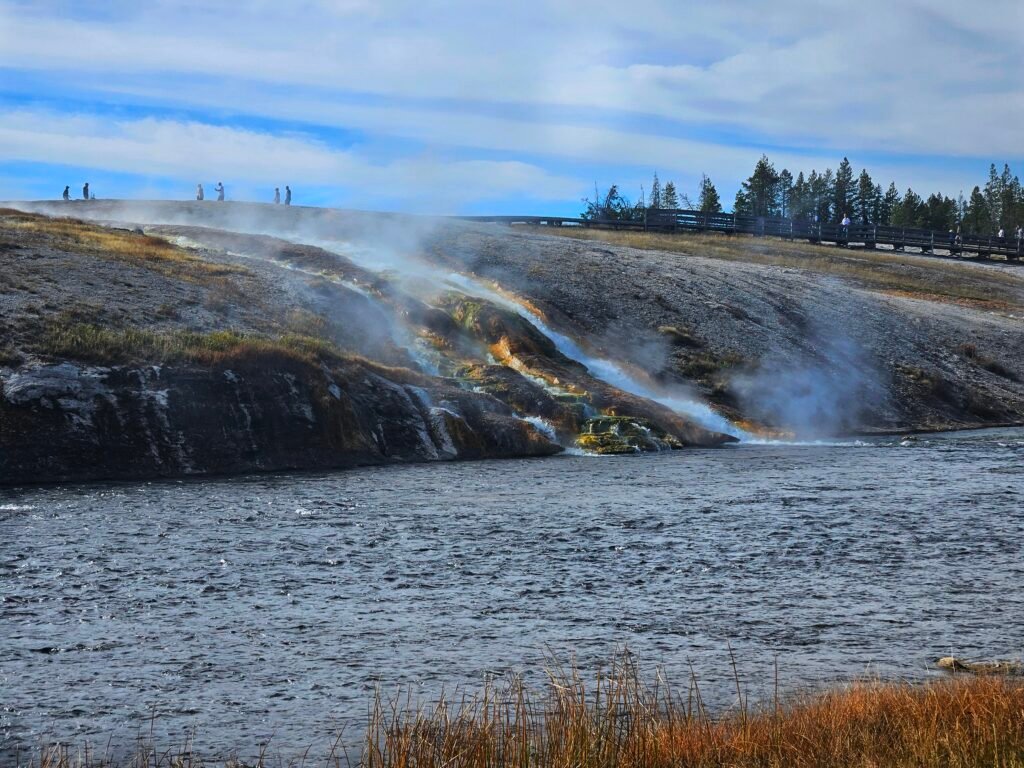
Parking was a little bit tricky as most lots were full even in October, and we ended up with a little bit of a jaunt. Instead of walking along the road, we chose to go down the hill and stroll along the banks of the Firehole river that runs in front of the basin. Rivulets of boiling water flow down from the basin and into the river which flows out into grassy plains and through pine trees.
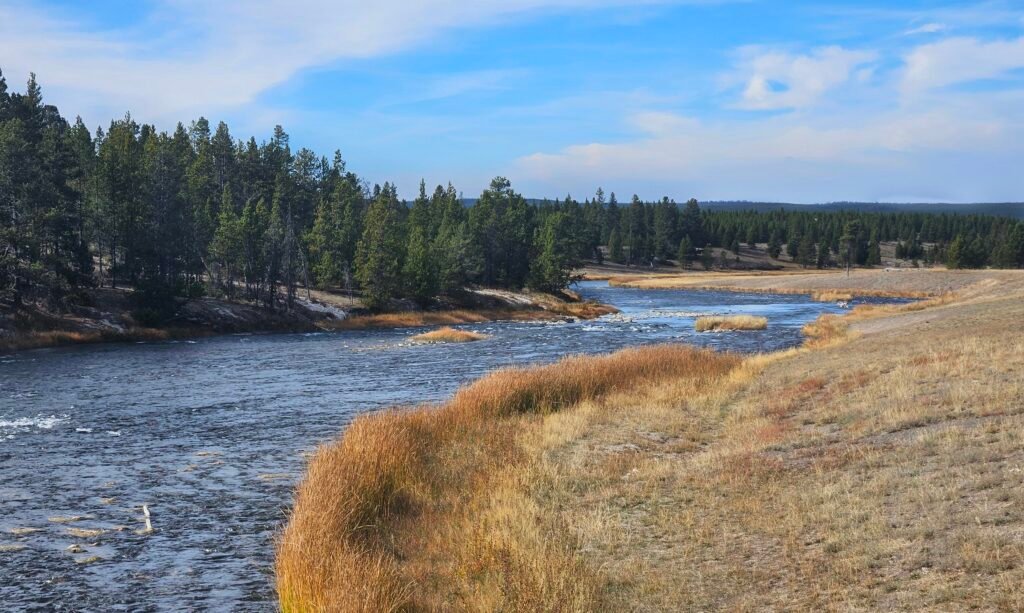
The boiling water comes from the Excelsior Geyser Crater which dumps over 4000 gallons of water per minute into the river.[5] Though this geyser has been dormant since 1985, the former explosions could sometimes include rock and mud along with the jets of hot water.[6] Currently, however, the crater features turquoise blue waters surrounded by craggy rock walls. From certain angles, it looks like the tranquil blue waters of the Mediterranean and feels fairly peaceful. Though the acid green and orange thermophiles that thrive on the bubbling waters that flow over the edge of the basin and into the river give the impression of an alien world.
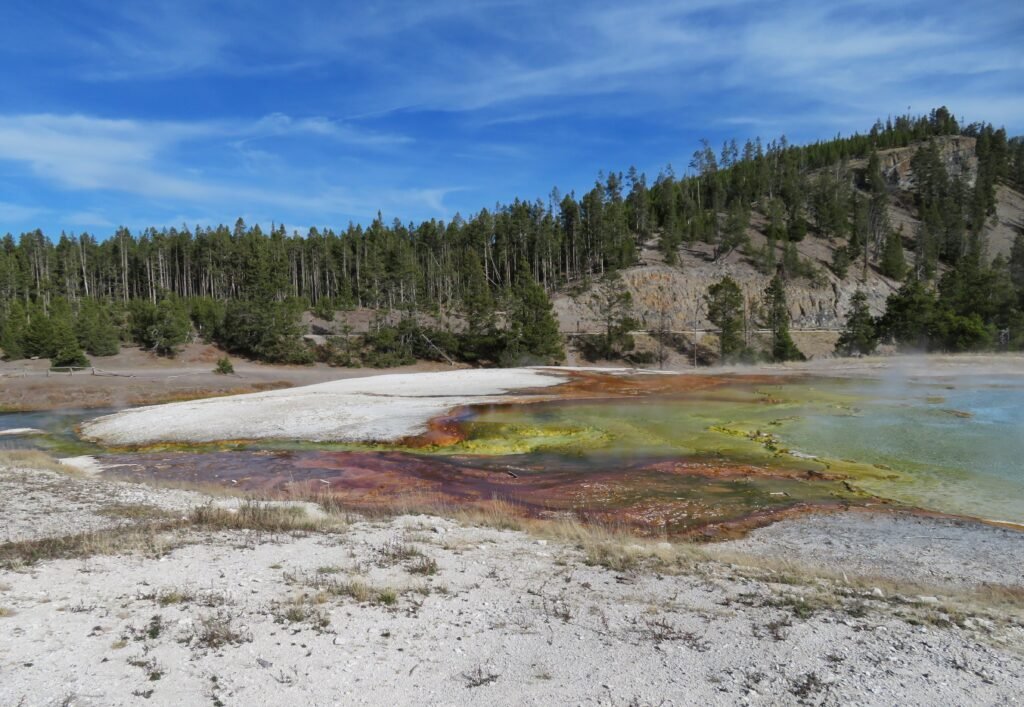
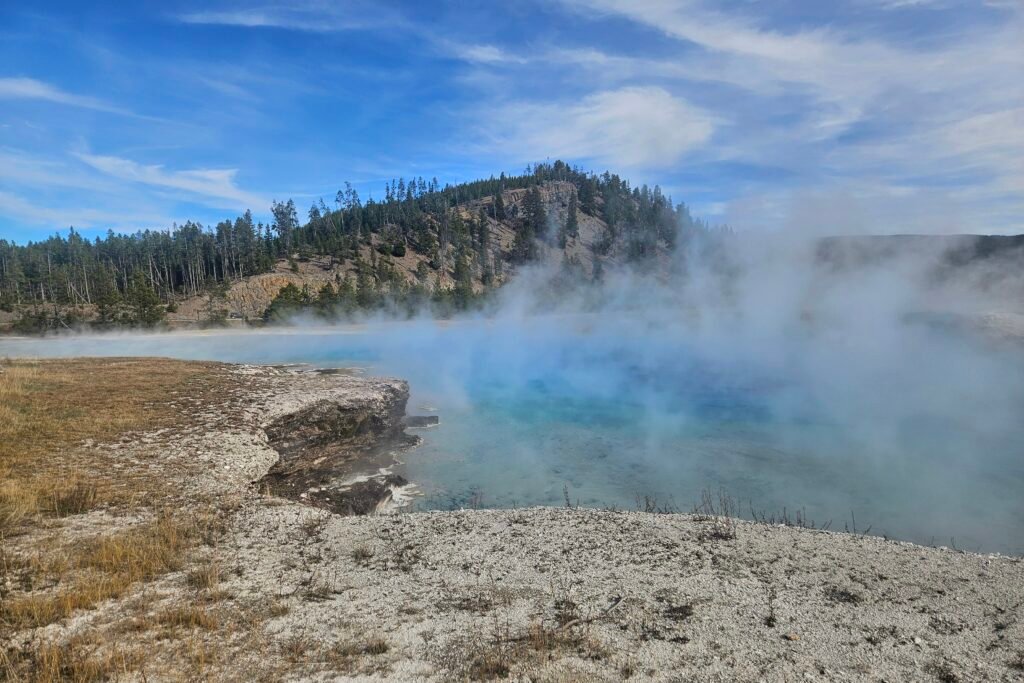
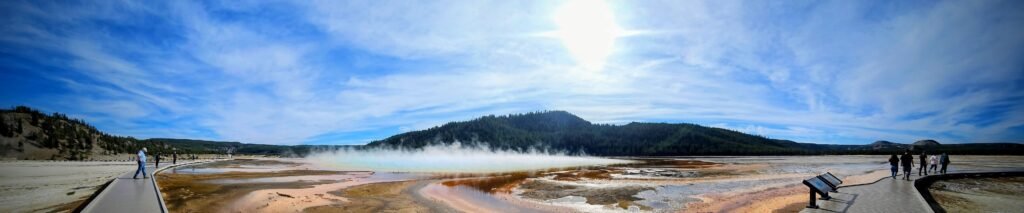
Just beyond Excelsior is the Grand Prismatic Spring. This is a large pool of water that goes from deep blue in the center to turquoise, yellow, orange, and red as it spreads out. The vivid waters have become one of the most iconic sights in Yellowstone.
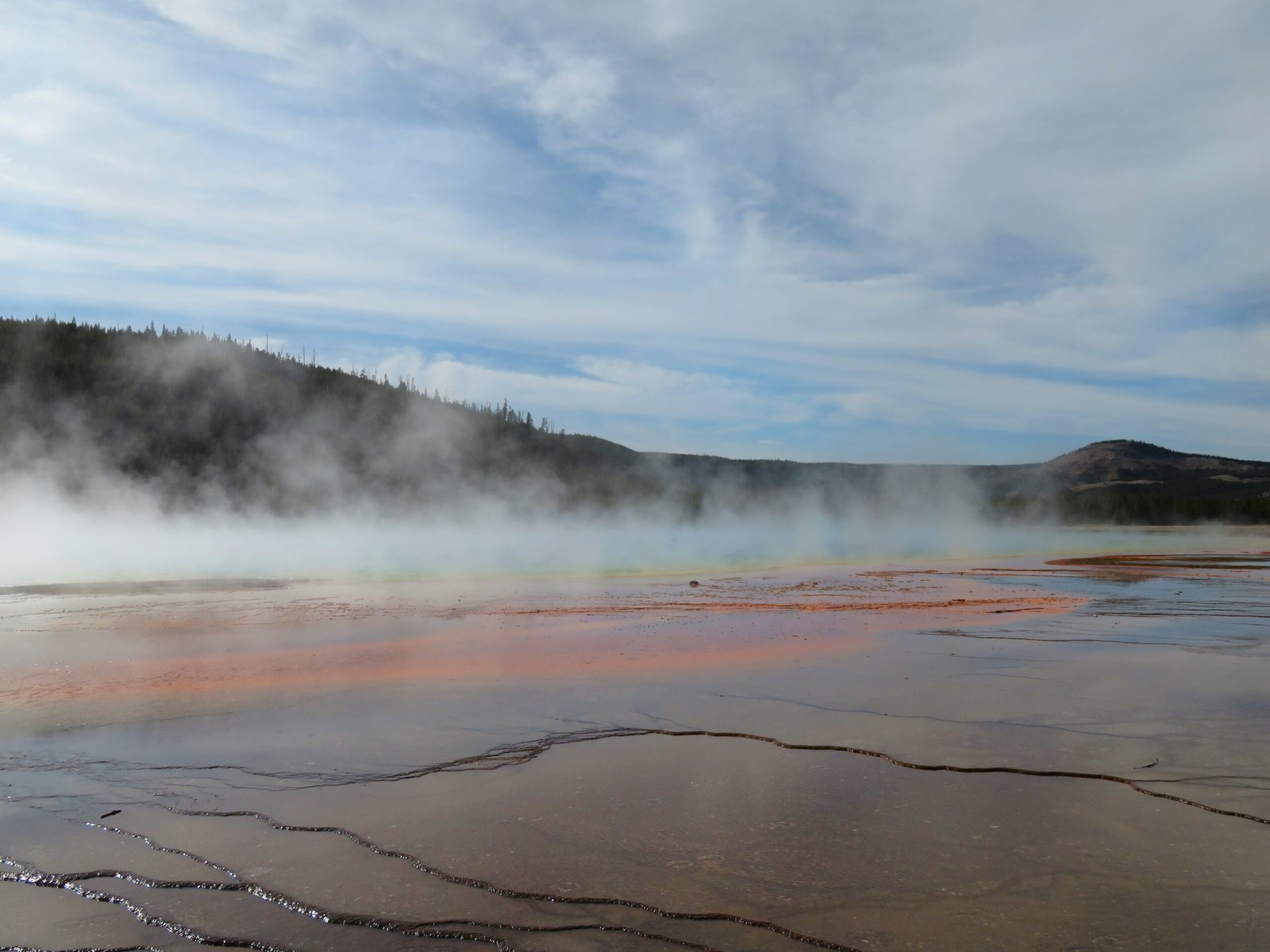
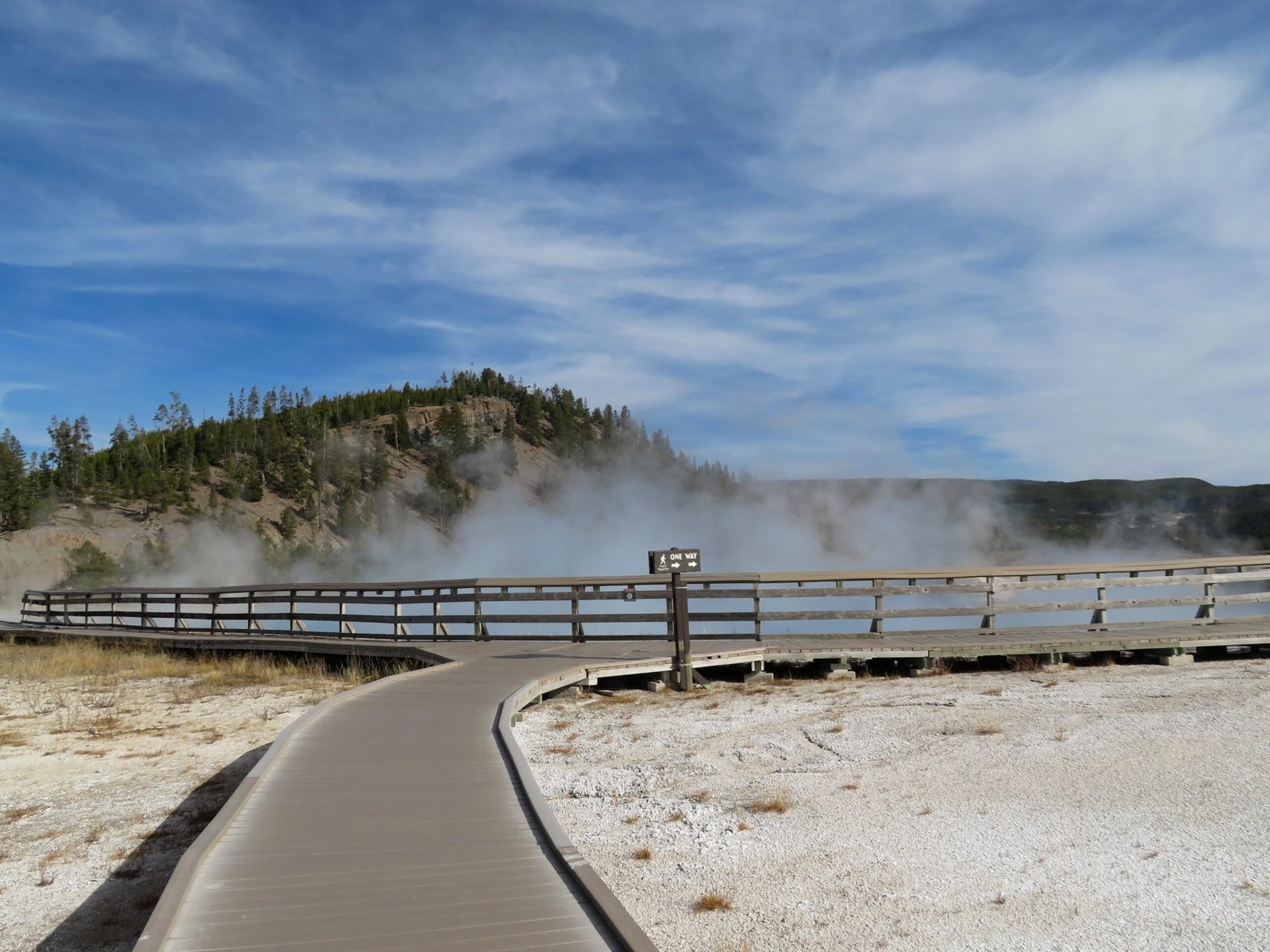
It was a little bit less iconic on the day that we went, though still magnificent. The weather was just cool enough to create these huge, billowing clouds of mist that piped off the surface of the hot waters, so our view of the intense blues, greens, and yellows in the center of the spring were limited. But turning up the contrast in the photos allows a slight glimpse into the vibrant colors that make this landmark so unique. Even without witnessing the entire rainbow effect, the rich reds and oranges on the outer rim were still breathtaking, as were the rippling, mineral terraces around the outside.
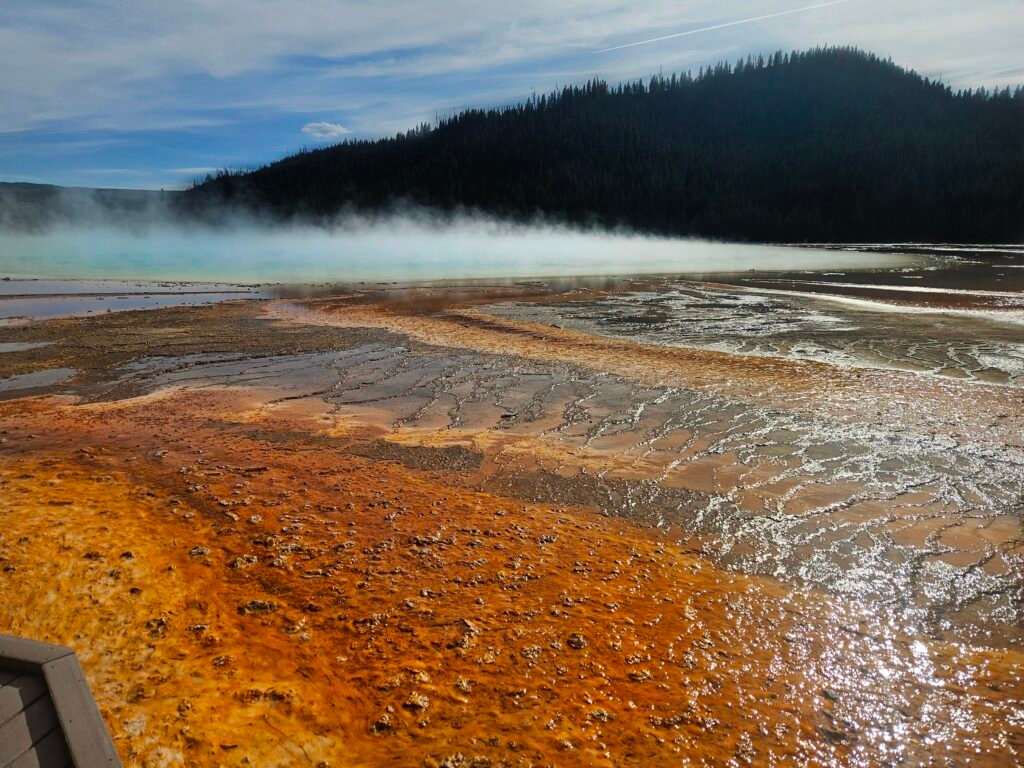
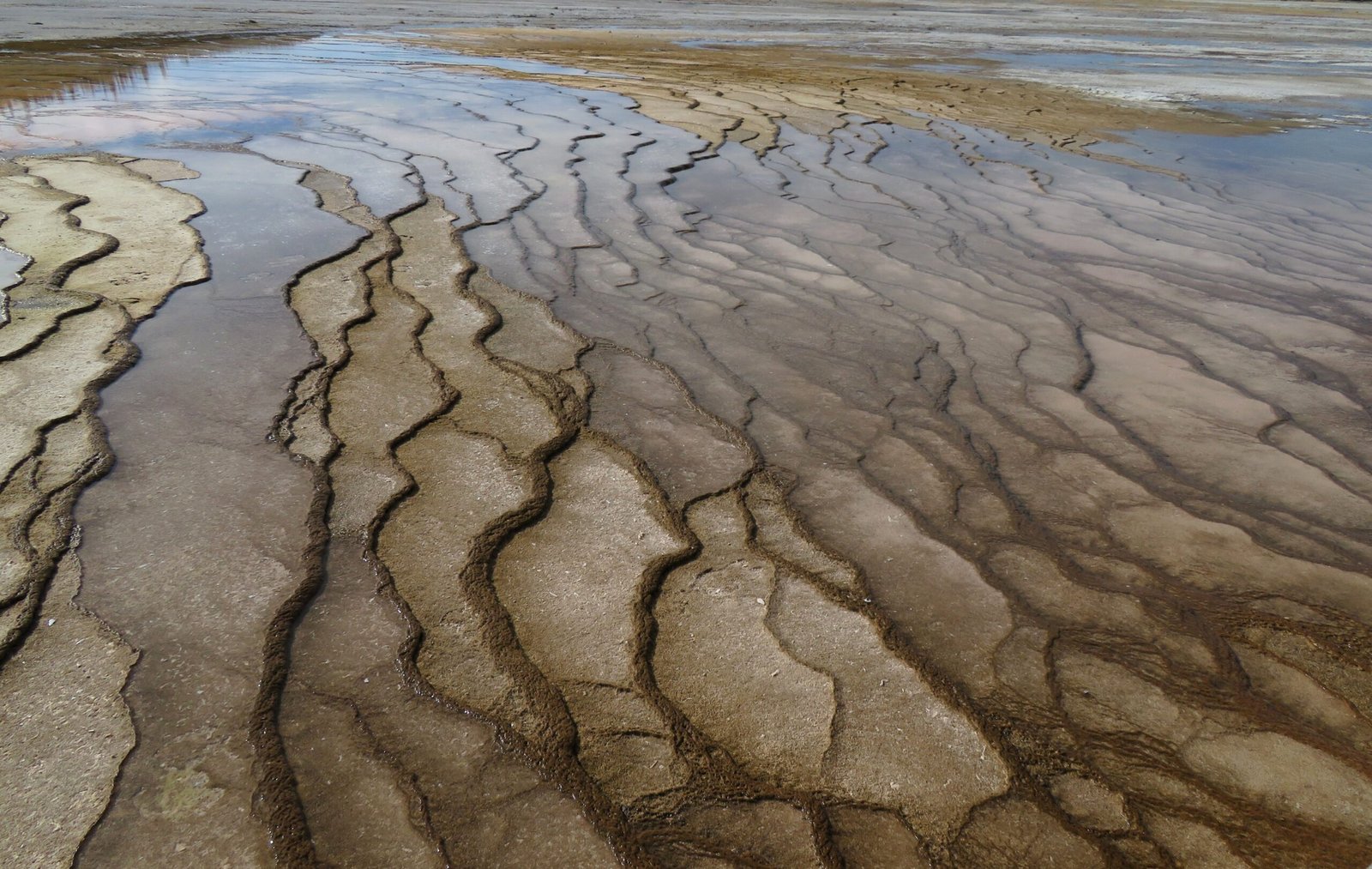
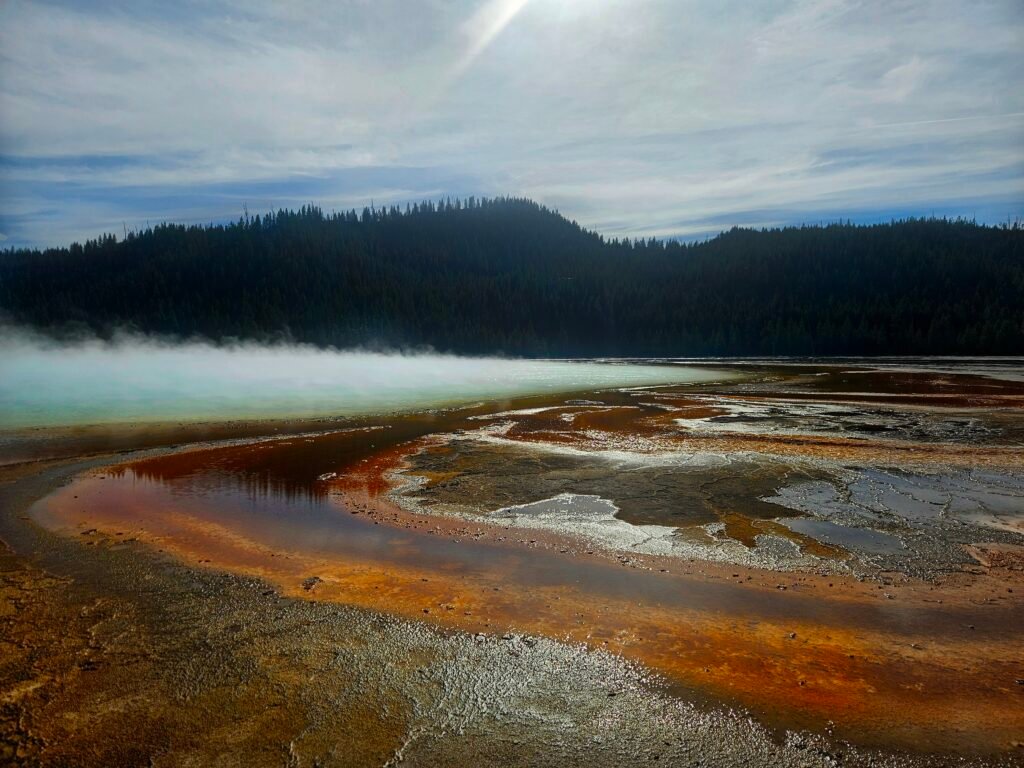
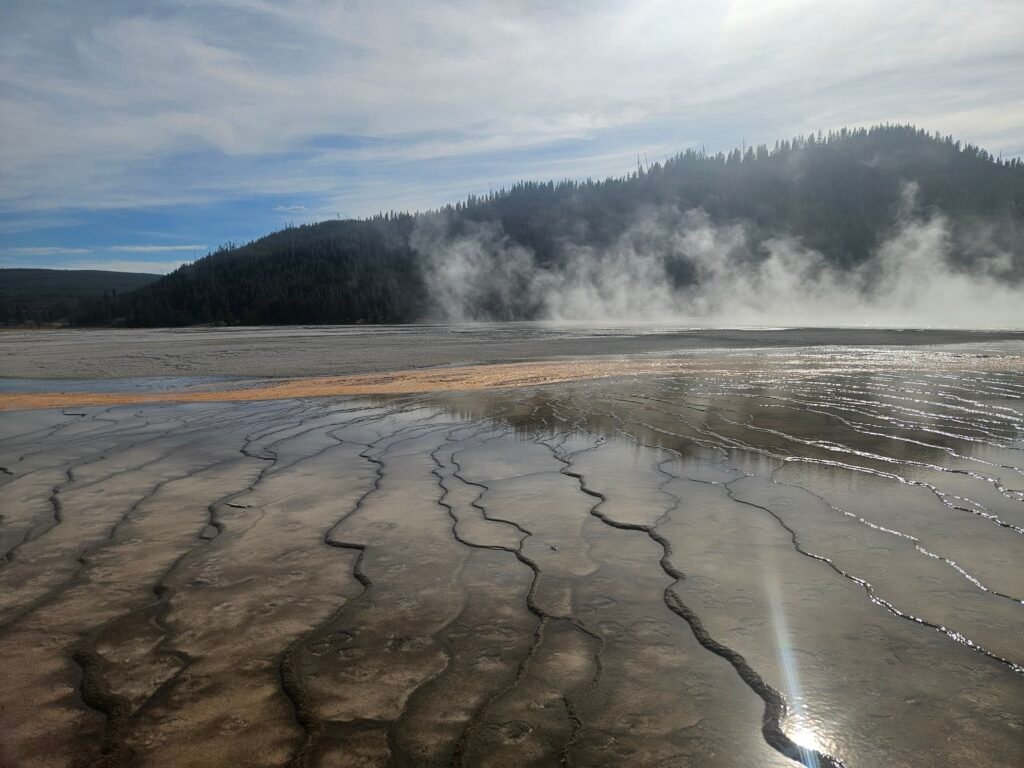
There is a path that leads to a Grand Prismatic Spring outlook where you can get a bird’s eye view of the water in all its multi-colored glory, but we didn’t take it on this trip so I can’t say how challenging the hike is.
The milky blue waters of the Opal Pool and the vivid shades of the Turquoise Pool round out the captivating beauty of the Midway Geyser Basin. These pools are much smaller than the other two features, but the colors are so vibrant that you can happily stand and stare at them for a good long while.
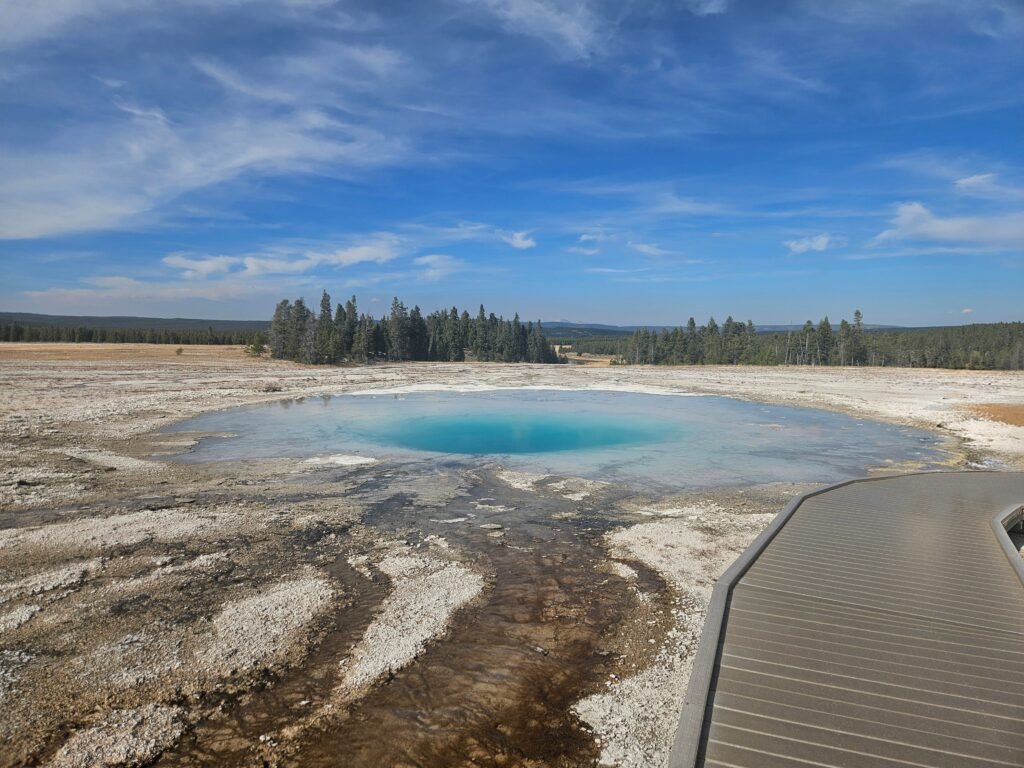
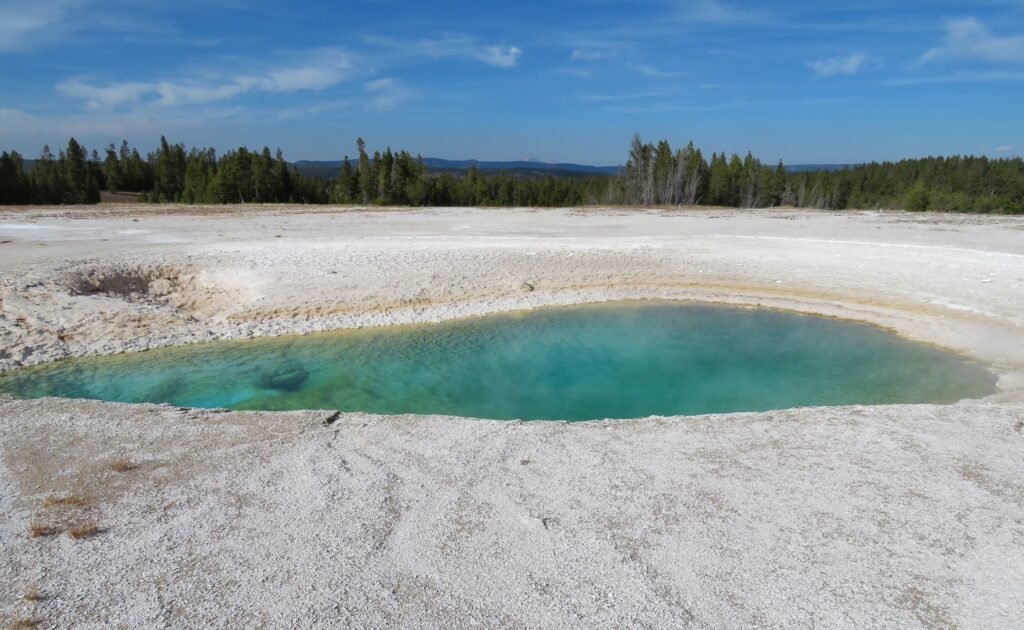
The boardwalk in this area is also a very easy walk with minor climbs and largely even pathways, making this a great stop if you need a rest from more intense hikes without sacrificing an amazing view.
The Grand Canyon of Yellowstone
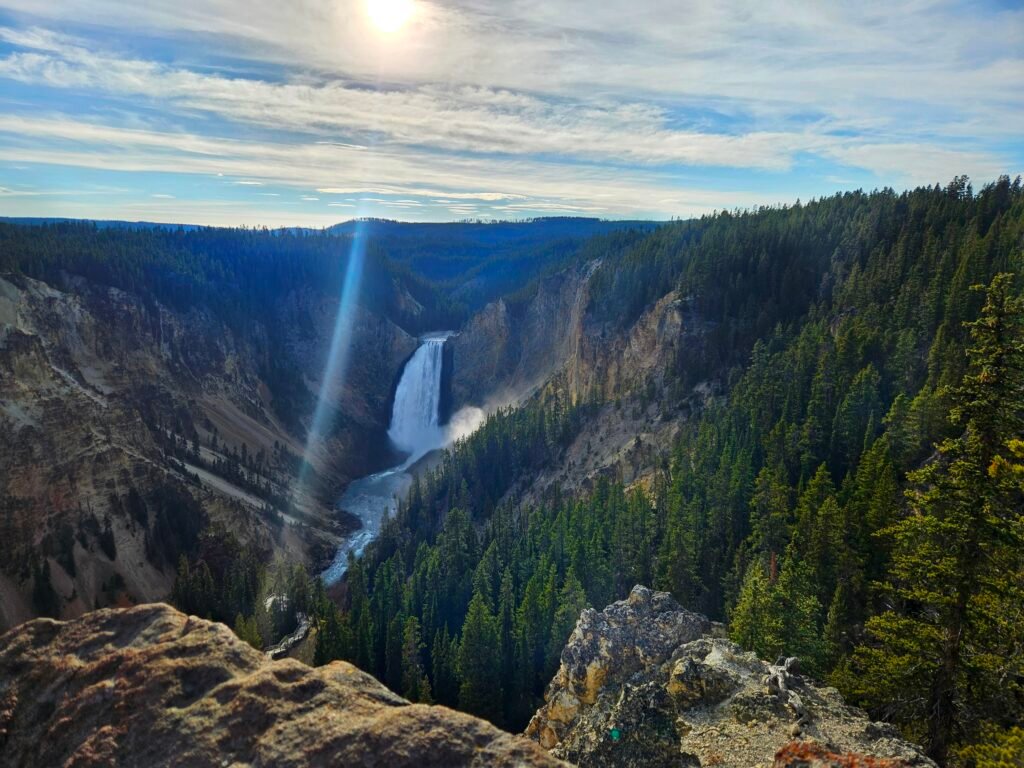
There are a lot of impressive sights to see in Yellowstone, and the great views of wildlife are a big part of that list. After we left the Midway Geyser Basin, we took a quick stop to admire this field full of grazing elk. I was hoping to spot a bull elk, but no such luck.
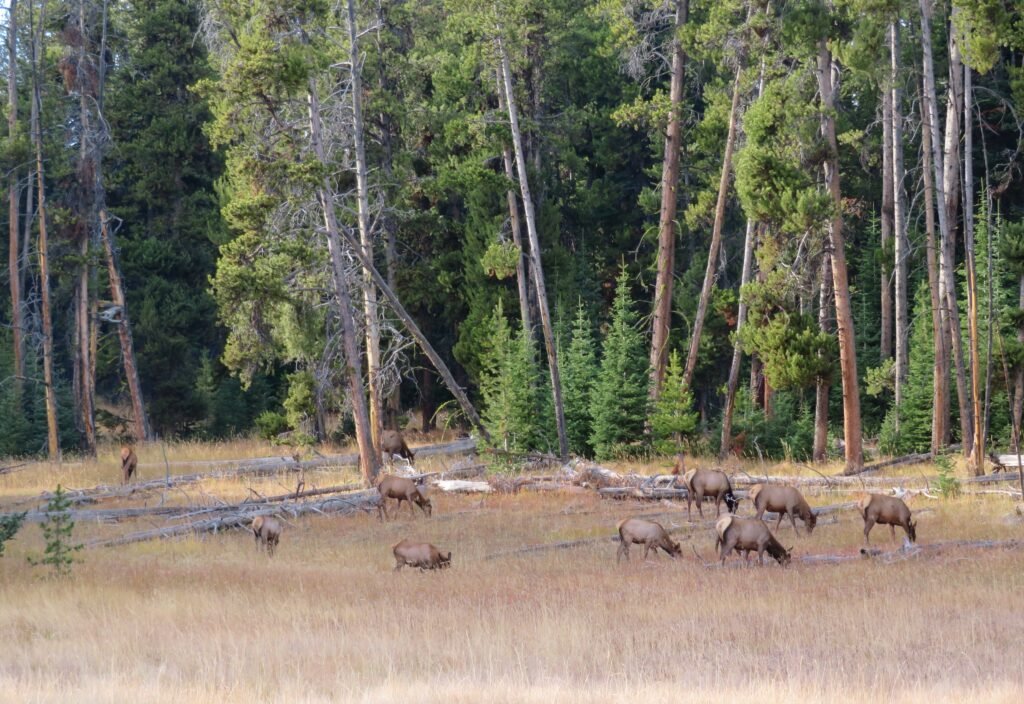
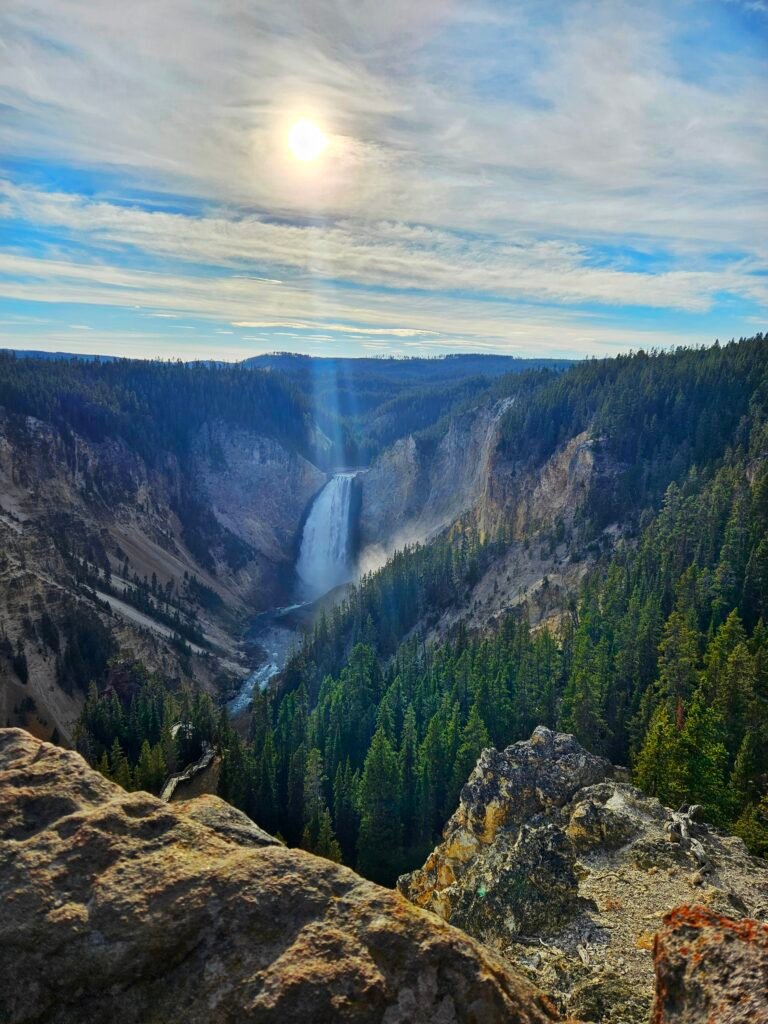
From there we headed towards the Grand Canyon of Yellowstone. Honestly, I don’t think I realized that’s where we were. We just saw a sign for an overlook and turned in to catch the magnificent view which turned out to be the lower falls of the Yellowstone river. It’s a magical sight that looks like it belongs in an 80s fantasy film. There are several great views and hikes around this area. The river carving its way through the wooded mountains offers fantastic scenery at pretty much every angle.
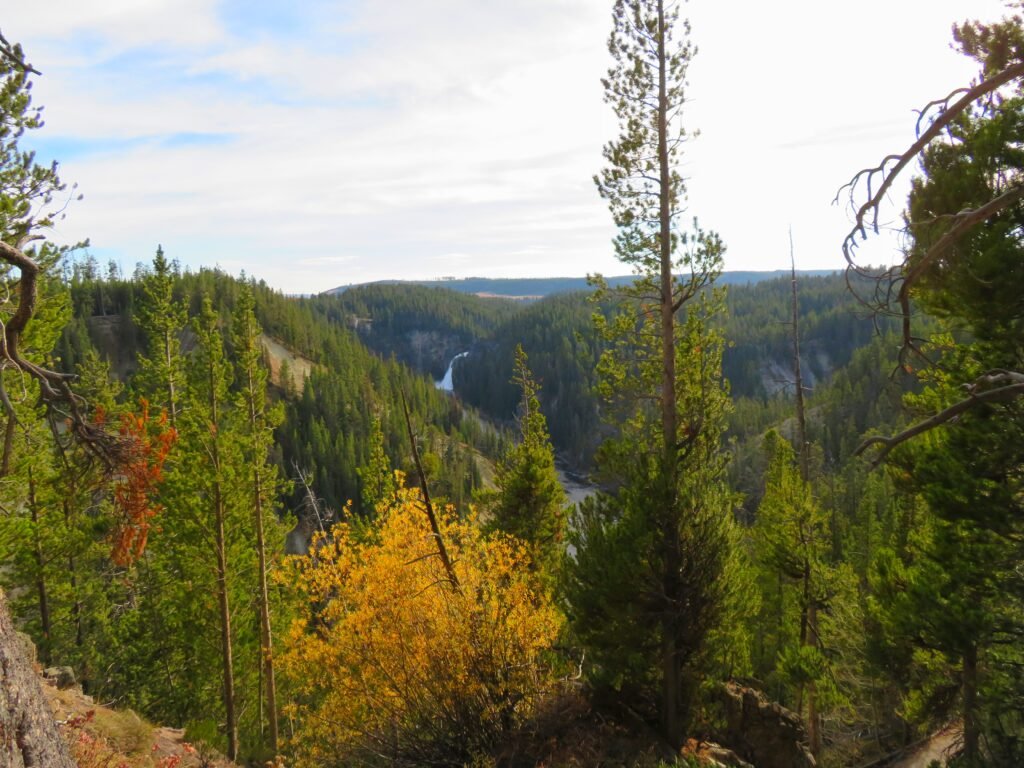
We headed on to the Brink of the Lower Falls Trail, which would have led us right to the waterfall we had glimpsed through the trees. This trail is about 0.8 miles round trip. But don’t let that easy distance fool you, it’s still an intense walk. The trail is paved, but also broken and uneven, has tight switchbacks, and drops down 600 feet.[7]
If you’re like me and somewhat geographically challenged, you may be having a hard time visualizing just how deep that goes. According to my google search, that’s roughly the length of two football fields, or the height of a ~50-story skyscraper. And there’s no elevator option. This trail is great for some quick adventuring but best avoided by those who may be low on stamina or balance.
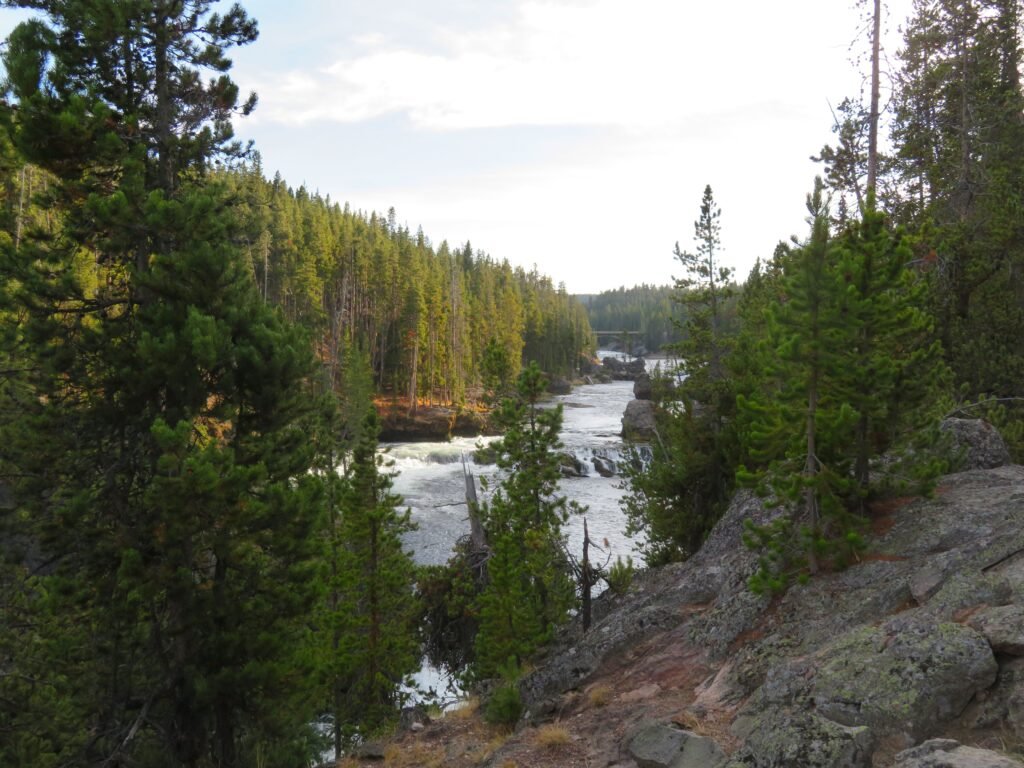
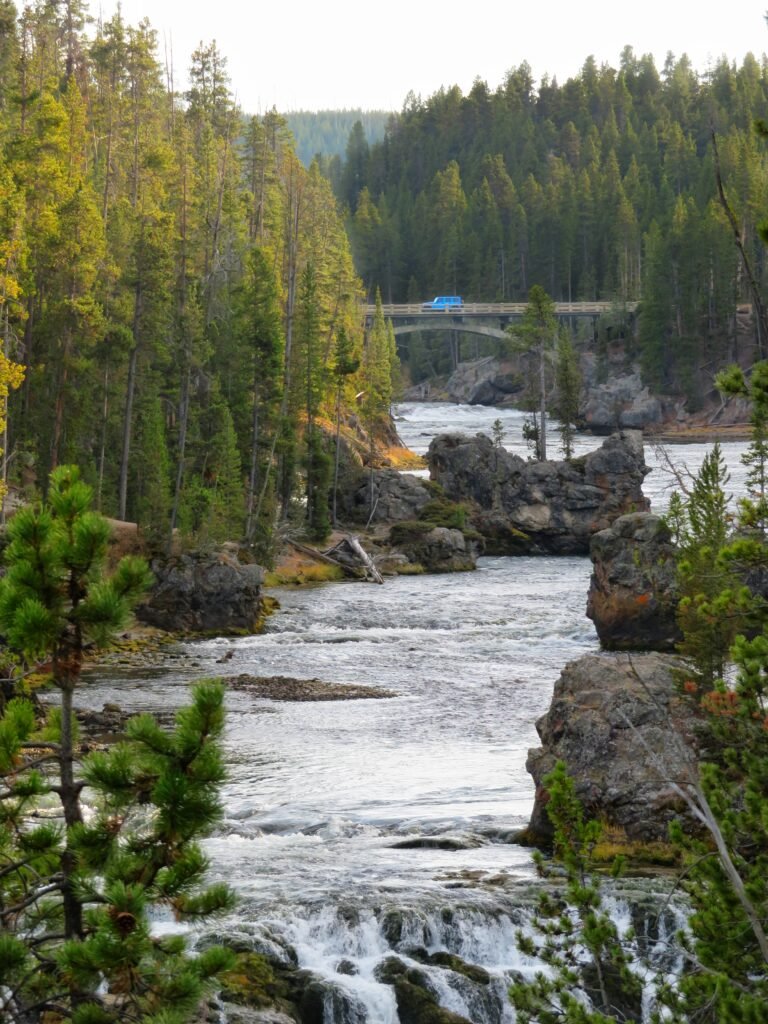
We took the path part of the way down but ultimately decided we didn’t want that 600-foot climb. Instead, we drove on to the much more accessible view of the upper falls. At this stop, a set of stairs leads down to an overlook that allows you to take in the rushing waters of the upper waterfall in all its force and glory. On the other side of the overlook, you also get a beautifully picturesque view of the Yellowstone River flowing through the trees. I would 100% recommend this beautiful spot.
More Animals
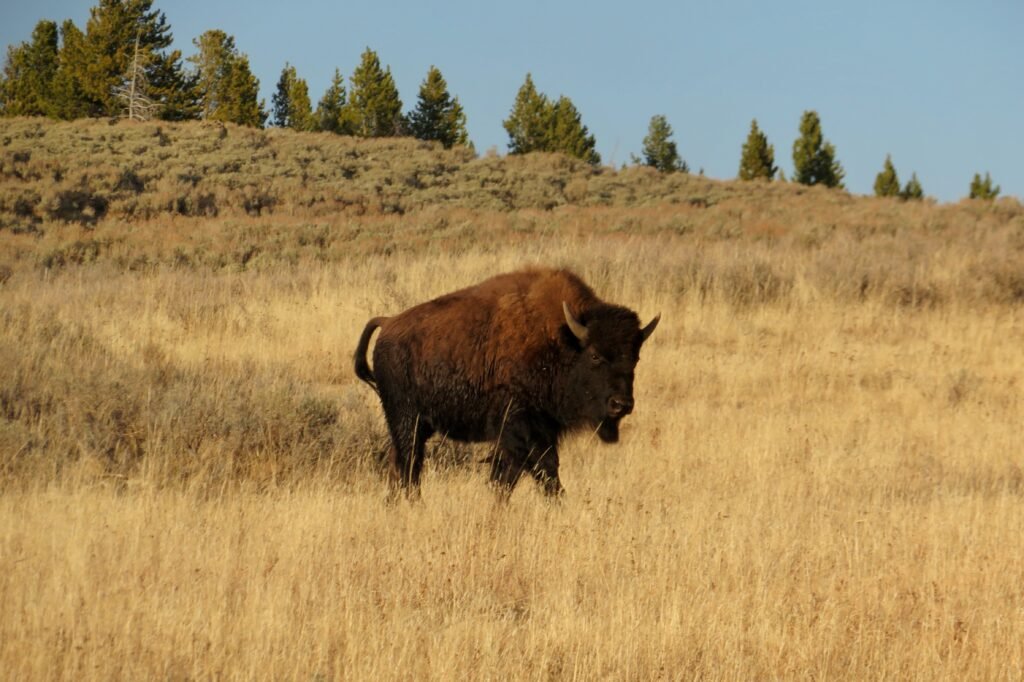
We had very high hopes of seeing wolves on our visit to Yellowstone. Wolves were not welcome in the area for decades as they were considered a threat to elk and livestock which didn’t please nearby settlers.[8] They had been almost entirely eradicated by the1940s.[9] But in the 1970s, wolves were recognized as endangered and preservation efforts began.[10] In 1995, wolves were reintroduced into Yellowstone to restore native species and to help with natural predation.[11] Due to reintegration efforts, there are now 8 wolf packs in Yellowstone made up of at least 84 wolves at last count.[12]
And because I think that they are awesome, I was definitely on the lookout for wolves.
And I wasn’t the only one. There is this fun thing that happens in Yellowstone where you see strangers stopped on the side of the road looking at something and you just…join in. These strangers are usually happy to tell you that they’ve seen something interesting and point it out, glad to share the experience.
Just make sure that you’re joining people who aren’t doing something dangerous. There are lots of stories about visitors getting a little too comfortable with the wildlife and ending up in trouble. If someone says something like, “we saw a bear go through those trees just right over there! We’re going to go look!” maybe advise against it and stay in your car. Don’t become a statistic for a photo op.
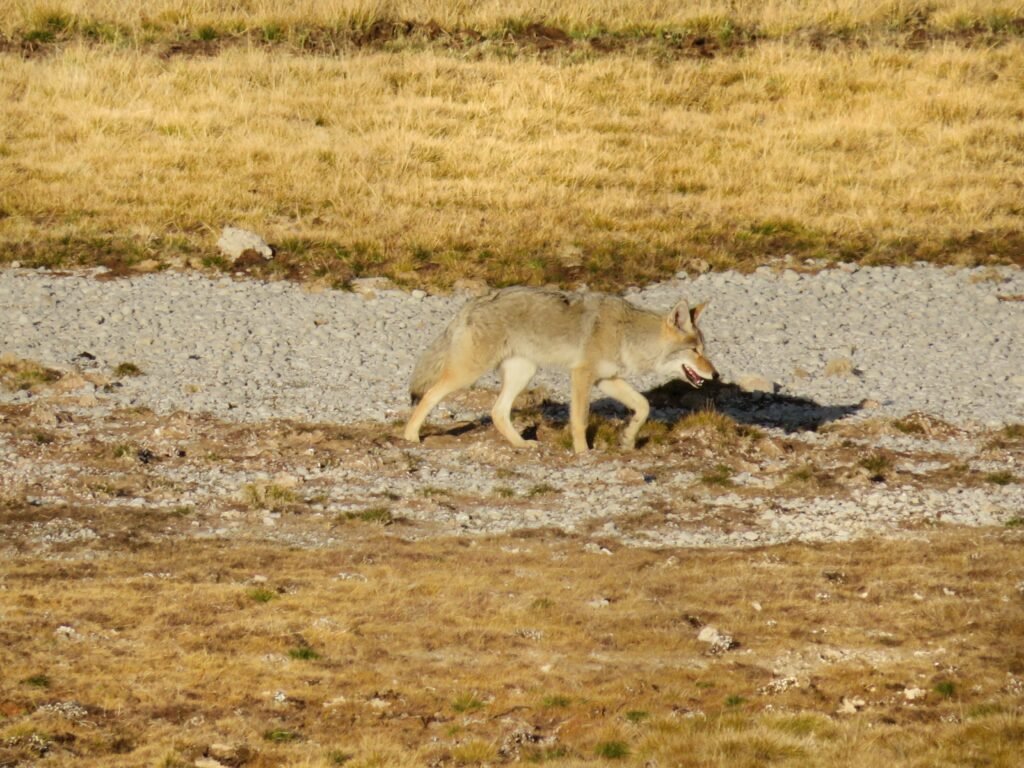
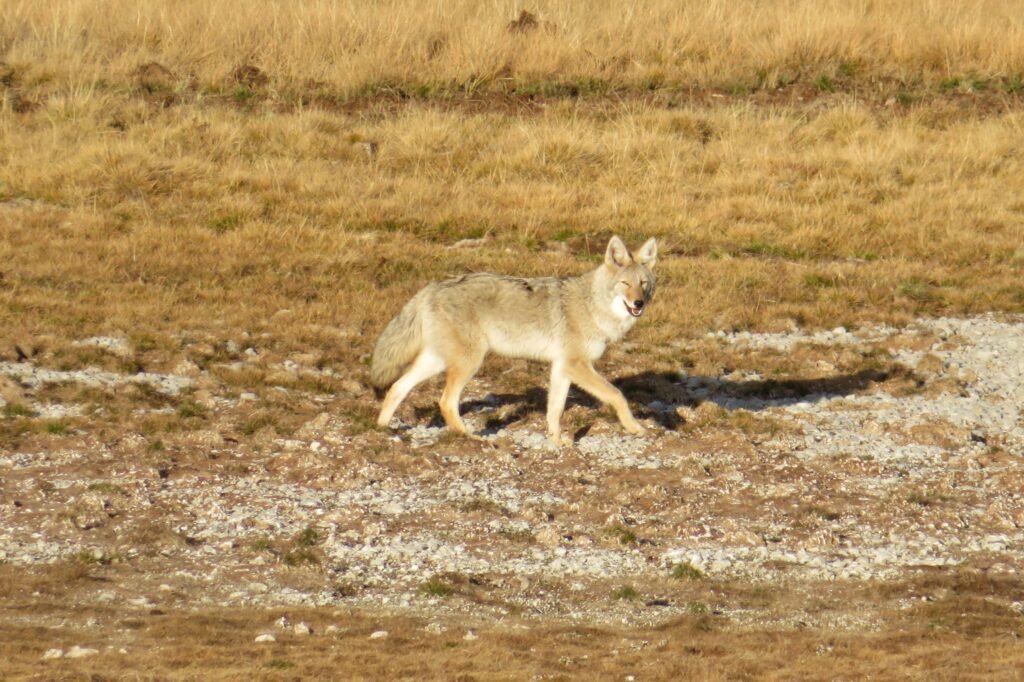
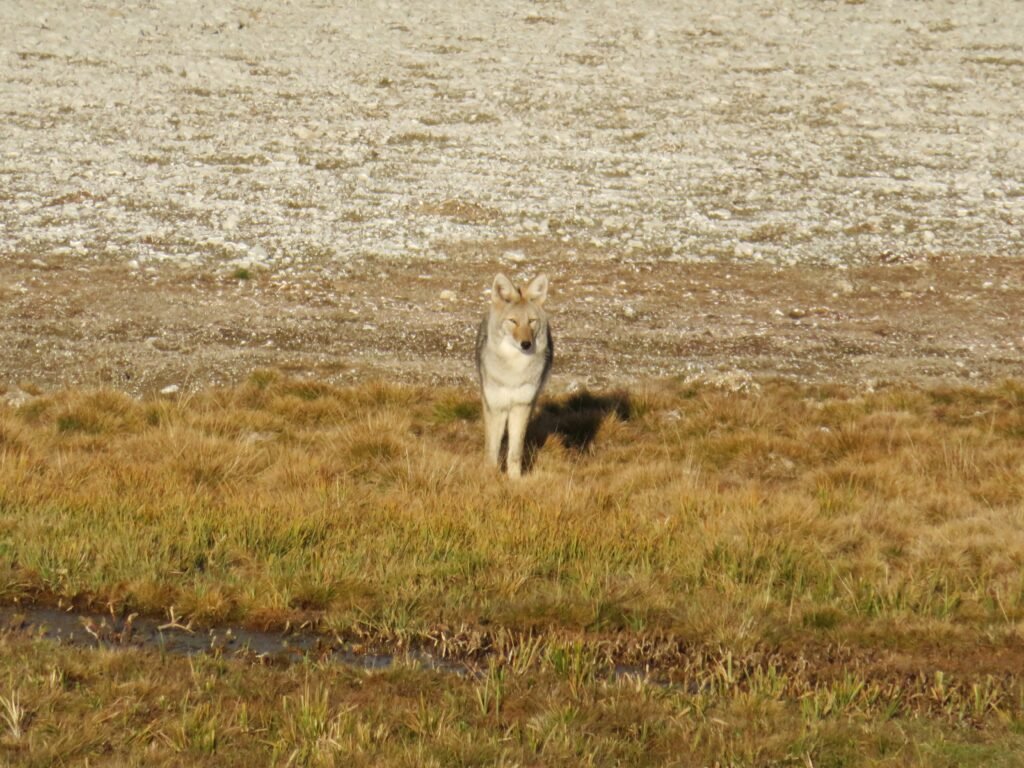
The best case of this phenomenon happened when we came across a group that said they had spotted a wolf! And it was in a valley below the bluff we were on, so it was a perfectly safe viewing opportunity. We had to tromp a bit away from the road to get a good look, but there it was, looking all sleek and magnificent.
Only one problem.
It was not a wolf.
One of the people in the impromptu group said that it was actually a coyote. I had been sure it was a wolf because I had seen coyotes before, and they had never looked so majestic. Sadly, this stranger was correct. Coloring, ear, leg, and paw size, and behavior all pointed to coyote.[13]
I later realized that I had only seen coyotes in the Arizona desert. They had all seemed lean, hungry, scraggly, and small. Probably because in Arizona, it’s just too darn hot to look majestic.
Even though it wasn’t a wolf, it was still a beautiful creature, and it was fun to see.
We weren’t giving up on the wolves. We had decided to head to the Hayden Valley Overlook because we had been told it was a good place to see wolves at dusk. On our way there, we were stopped by another bison crossing. But this wasn’t just a single buffalo, it was an entire herd. Dozens of these behemoths were ambling down the grassy hillside, across the road, and into the rolling plains towards the valley below.
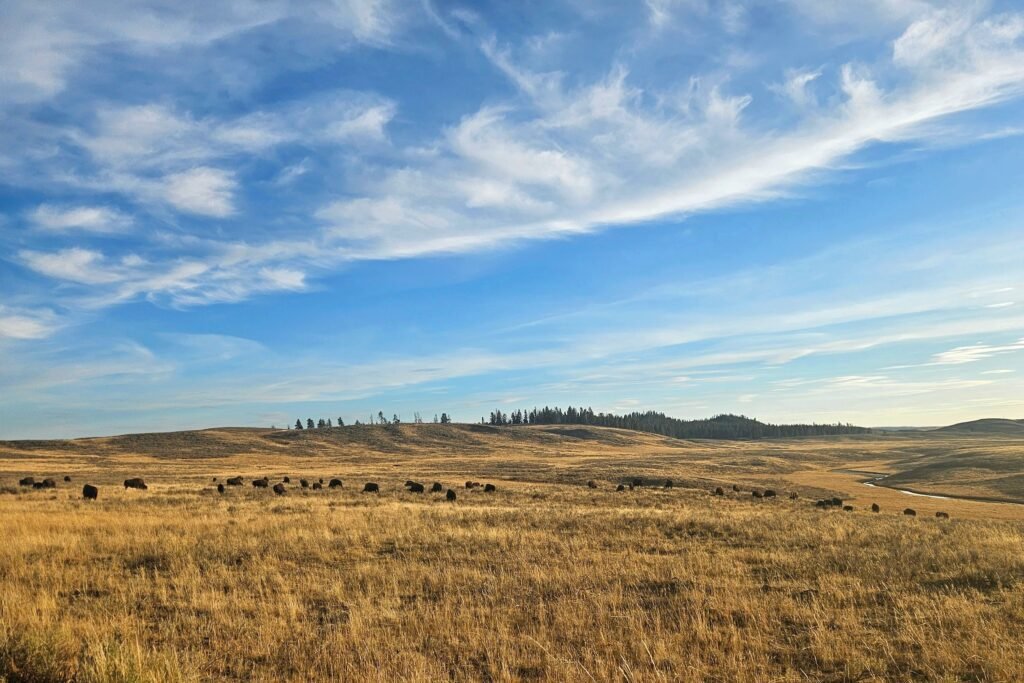
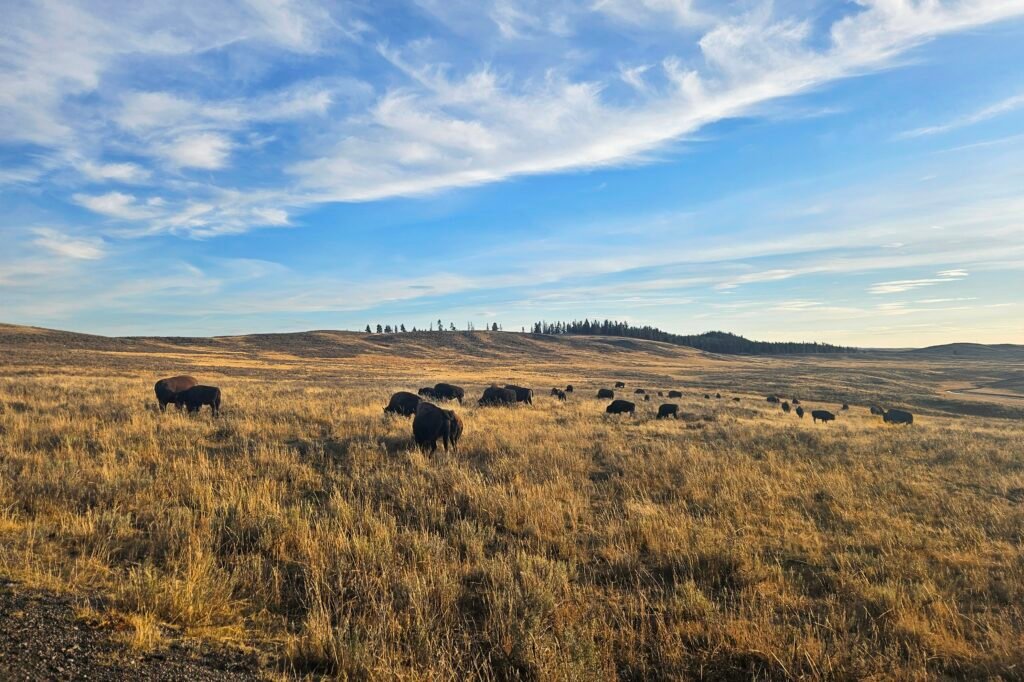
I took a weird delight in waiting for the bison to cross. It was a great moment of just letting life roll over you and enjoying every minute. The ideal picture of the American west.
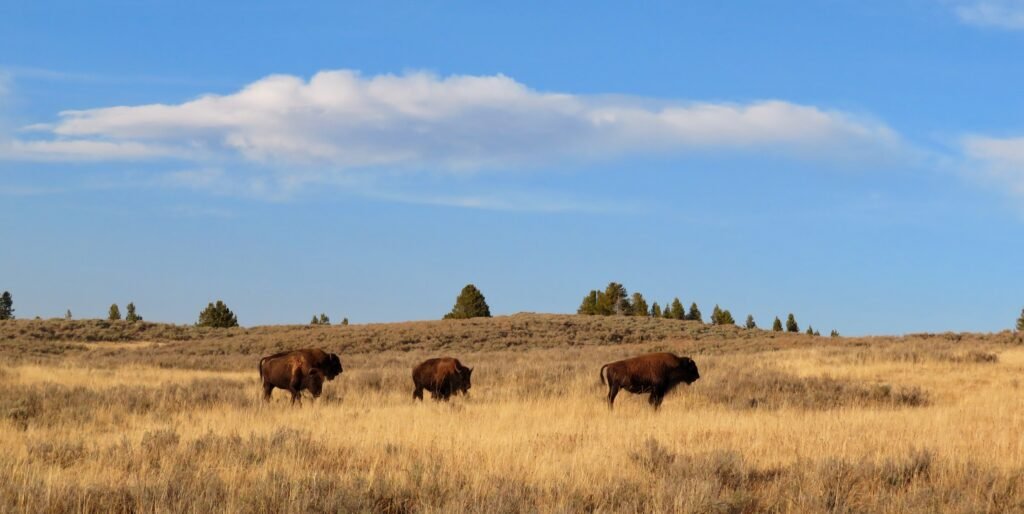
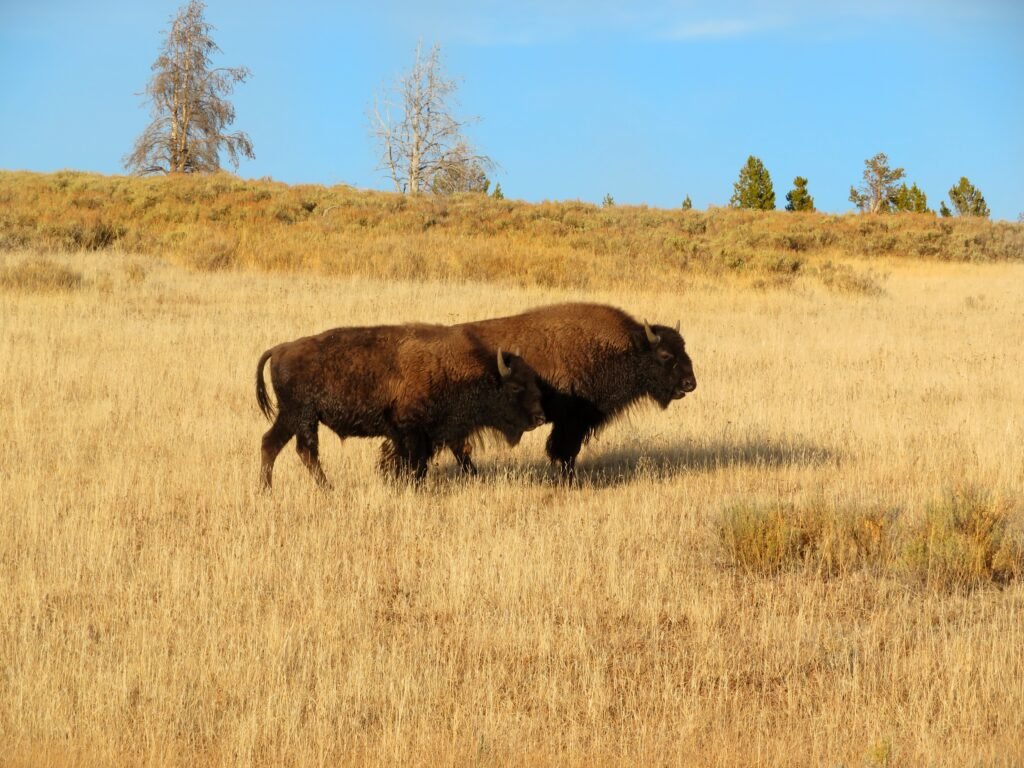
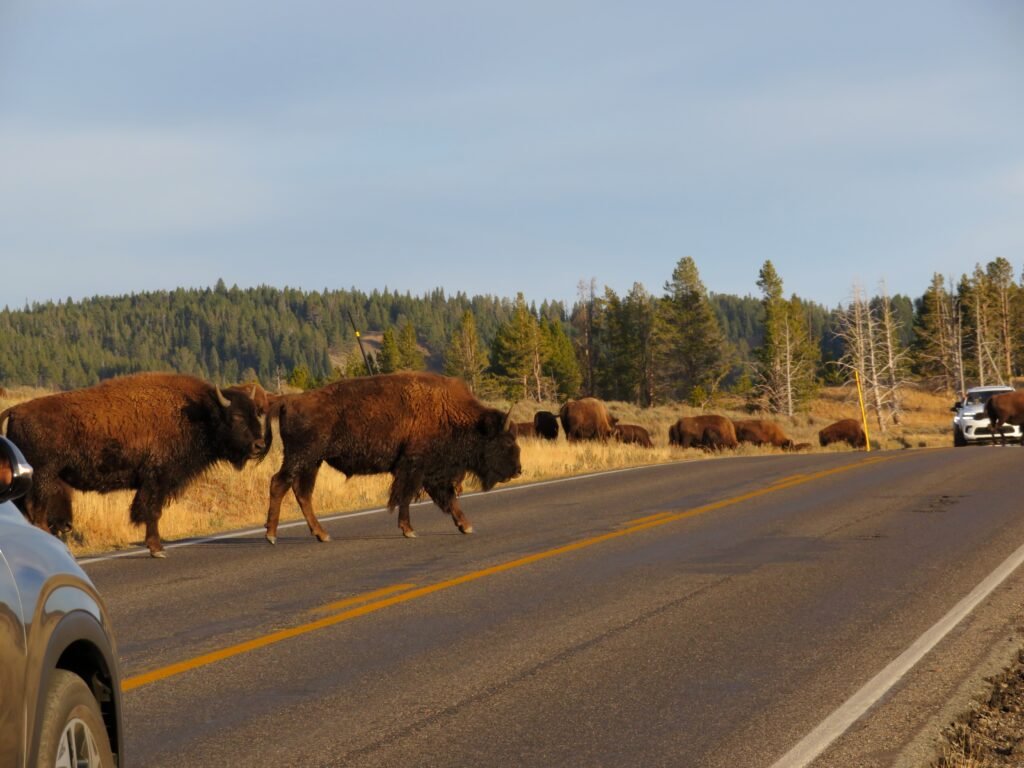
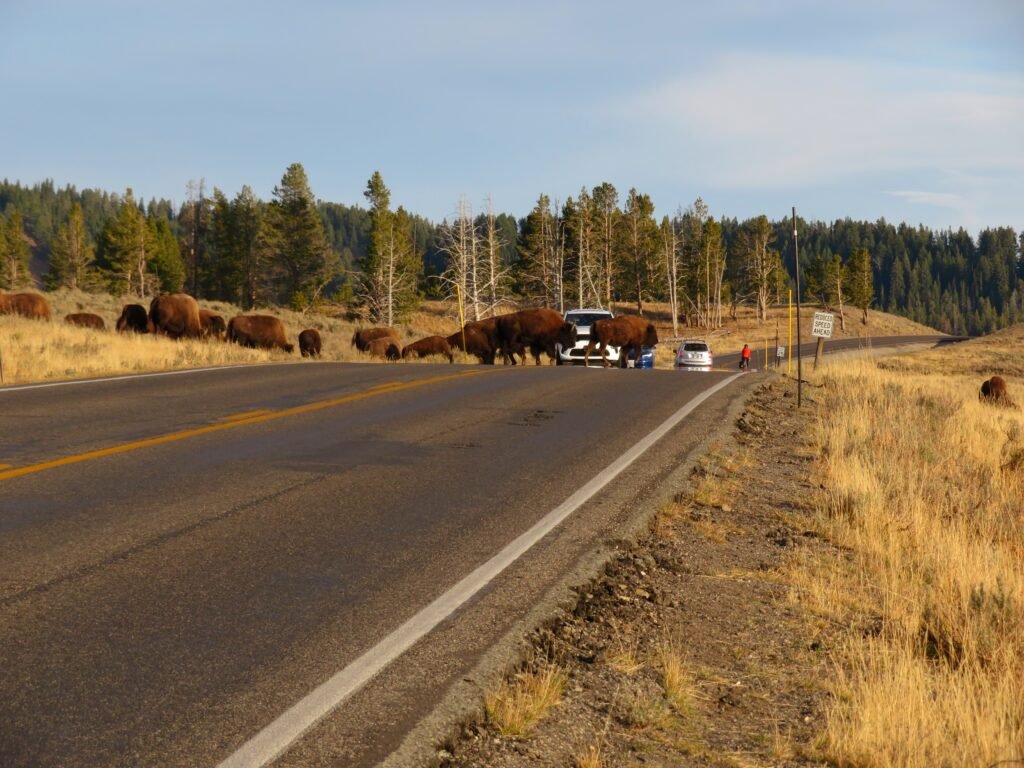
Eventually, the bison finished crossing and we made our way to the overlook.
In Hayden Valley, the Yellowstone river cuts through grassy plains in front of rolling hills that give way to majestic pines. It was a peaceful view, even if it did get chilly as the sun started to go down.
We never saw any wolves. I did spot a couple of lone bison and a pine tree that, from a distance, looked a bit like bigfoot walking his dog. But mostly, we just watched as the sunset transformed the landscape, turning the hills pink as the light faded to dark.
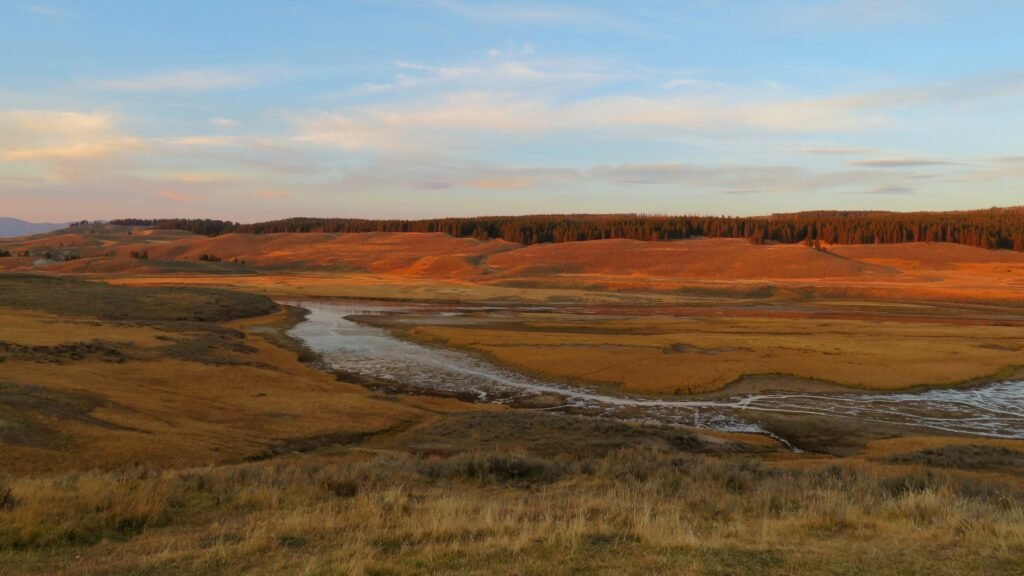
Soon, it was time to leave the park again.
We did see many other animals as the sun began to set. Swans and ducks that were nesting down, and a fox on the hillside, preparing for an active night. And, silhouetted on a hill, illuminated by the last of the sunlight, we saw a bull elk.
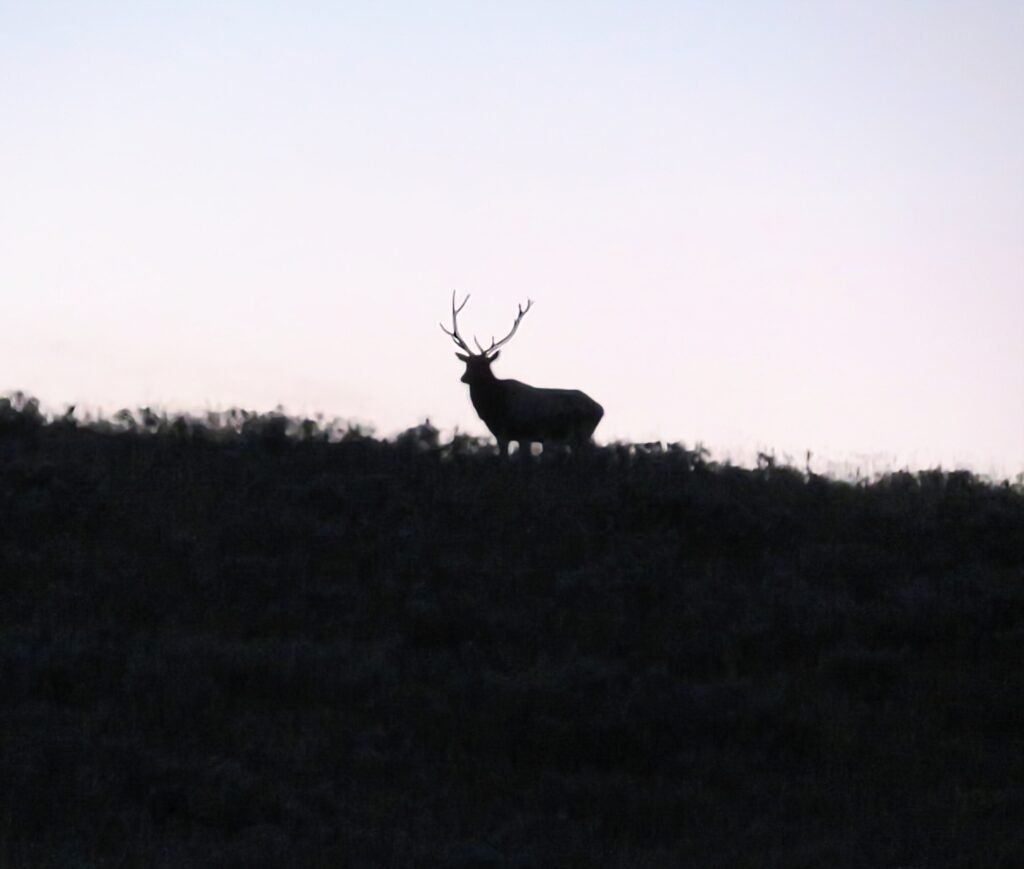
He looked very regal and cinematic.
It was a great way to end our time in Yellowstone as we headed out of the park for the last time. For this trip, at least.
To Sum Up
Go to Yellowstone.
It’s beautiful and rejuvenating and you’ll see wonderful, wild things. There’s so much more to see than what I experienced. Going here helped give me an emotional reset that kept me sane for at least a month after I returned to an unsatisfying job. And the park services have done a great job at preserving nature while making it easy for guests to see and experience the wonder. I 100% recommend this beautiful national park.
[1] 15 Facts about Bison (U.S. National Park Service). (n.d.). https://www.nps.gov/articles/15-facts-about-bison.htm
[2] Old Faithful Geyser (U.S. National Park Service). (n.d.). https://www.nps.gov/places/old-faithful-geyser.htm
[3] Old Faithful Geyser (U.S. National Park Service). (n.d.). https://www.nps.gov/places/old-faithful-geyser.htm
[4] Associated Press. (2024, January 18). Old Faithful clock is faithful old self again. Deseret News. https://www.deseret.com/2000/11/16/19539270/old-faithful-clock-is-faithful-old-self-again/
[5] Excelsior Geyser Crater (U.S. National Park Service). (n.d.). https://www.nps.gov/places/000/excelsior-geyser-crater.htm
[6] The explosive story of Excelsior Geyser. (2024, August 5). USGS. https://www.usgs.gov/observatories/yvo/news/explosive-story-excelsior-geyser
[7] Brink of the Lower Falls Trail (U.S. National Park Service). (n.d.). https://www.nps.gov/thingstodo/yell-trail-brink-of-the-lower-falls.htm
[8] History of wolf Management – Yellowstone National Park (U.S. National Park Service). (n.d.-c). https://www.nps.gov/yell/learn/historyculture/wolf-management.htm
[9] History of wolf Management – Yellowstone National Park (U.S. National Park Service). (n.d.). https://www.nps.gov/yell/learn/historyculture/wolf-management.htm
[10]Yellowstone Forever. (2025b, July 21). Yellowstone Wolf Project. https://www.yellowstone.org/wolf-project/
[11] Wolf Management – Yellowstone National Park (U.S. National Park Service). (n.d.-b). https://www.nps.gov/yell/learn/management/wolf.htm
[12] Wolf Management – Yellowstone National Park (U.S. National Park Service). (n.d.). https://www.nps.gov/yell/learn/management/wolf.htm
[13] International Wolf Center. (2026, March 9). Was that a wolf? | International Wolf Center. International Wolf Center | Teaching the World About Wolves. https://wolf.org/wolf-info/basic-wolf-info/was-that-a-wolf/